


Outdoor cannabis is not a compromise. It is not what you grow when you can’t afford indoor equipment or when you don’t have space for a tent. Grown right—in the right climate, with the right genetics, and with sufficient attention to the variables that matter—outdoor cannabis is some of the best cannabis in the world. The sun is the most powerful grow light ever invented. Free, full-spectrum, and not available in any indoor configuration. Growers who understand how to work with it, rather than against it, produce plants that would embarrass most indoor setups by weight alone.
This guide covers outdoor cannabis cultivation from site selection through harvest—including what to grow, when to plant, what the plant needs at each stage, and what will try to kill it.
The Advantages of Outdoor Growing
Cost is the first advantage. Once you have seed, soil, water, and a shovel, the fundamental inputs are free. No electricity bill. No equipment depreciation. No HVAC management. An outdoor grower who plants in good soil in May and harvests in October spends a fraction of what an equivalent indoor setup costs per ounce.
Scale is the second advantage. A single outdoor plant in optimal conditions—good genetics, fertile soil, full sun, adequate water, warm climate—can produce 3 to 10 pounds of finished flower. An indoor plant in a 4×4 tent produces 3 to 6 ounces on a good day. For personal supply or small commercial production, outdoor growing is dramatically more efficient at scale.
Plant health is the third. Cannabis grown in real soil, with a living microbial community, develops root systems and structural integrity that containerized indoor plants can’t match. The terpene expression in well-grown outdoor cannabis often exceeds that of indoor equivalents—the plant accesses a broader mineral and microbial environment than any container medium can provide.
For a direct comparison of the two approaches, see our full guide to indoor vs. outdoor growing pros and cons.
Climate Requirements for Outdoor Cannabis
Cannabis is a warm-season annual. It needs a frost-free growing window of at least 4 to 5 months, consistent temperatures above 60°F during the growing season, and long days in spring and summer to trigger vigorous vegetative growth before shortening days induce flowering.
Ideal U.S. growing climates: The Pacific Northwest (Humboldt, Mendocino, Trinity counties in California), the Emerald Triangle, coastal Oregon, the Willamette Valley, and the Southwest (New Mexico, Colorado’s Western Slope, Arizona’s higher elevations) consistently produce exceptional outdoor cannabis. Mediterranean-climate regions with warm days, cool nights, and low late-season humidity are the gold standard.
Challenging but workable climates: The Southeast and Gulf Coast face high humidity in the late-season flowering window—a serious mold risk for dense-budded strains. Focus on mold-resistant genetics (open bud structure, dense-terpene profiles that repel insects and fungal pressure) if growing in these regions. The Upper Midwest and Northeast have shorter growing seasons; autoflowers or fast-finishing photoperiod strains are necessary for a reliable harvest before frost.
Hardiness: Cannabis is more climate-adaptable than most annual crops. It handles heat well (up to 95°F with adequate water), tolerates occasional cool nights (down to 50°F without damage), and can be grown as far north as Zone 5 with appropriate strain selection and start timing. For detailed guidance by region, see our guide on outdoor cannabis cultivation in different climates.
Selecting Your Growing Site
Site selection is the most important decision in outdoor growing. A bad site limits everything that follows, regardless of seed quality, amendment investment, or care. A great site makes everything easier.
Sunlight. Cannabis needs 6 to 8 hours of direct sun minimum; 10 to 14 hours produces the best results. South-facing exposures in the Northern Hemisphere receive the most sun throughout the day. Assess your site at multiple times of day and across the season—a spot that’s sunny in June may be shaded by neighboring trees or buildings by September when the sun’s angle changes. Cannabis in shade is cannabis that doesn’t reach its potential. For full site assessment guidance, see how to select the best location for an outdoor cannabis grow.
Drainage. Standing water kills cannabis roots by oxygen deprivation. Sites that pool water after rain are not suitable for in-ground planting without significant remediation (raised beds, drain tile, soil amendment). Slopes drain better than flat ground. Test drainage by digging a hole 12 inches deep, filling it with water, and checking how fast it drains—good drainage empties the hole in 30 to 60 minutes.
Airflow. Good airflow prevents fungal disease by drying leaf surfaces after rain or dew. Plants in open areas with natural air movement have significantly lower mold pressure than plants in enclosed, stagnant spots. Avoid planting in low-lying areas where cold air pools—these create humid, frost-susceptible microclimates.
Privacy and security. Legal status varies by state, and even in legal states, discretion has value. Natural screening (hedges, outbuildings, fences, tree lines) reduces visibility. Consider sightlines from neighboring properties and roads, as well as aerial views, before establishing a planting site.
Soil Preparation for Outdoor Cannabis
Native soil is rarely ideal for cannabis without amendment. Most garden soils are either too compact (poor drainage), too sandy (poor water retention), or nutrient-deficient for a crop as vigorous and demanding as cannabis.
Target soil characteristics: Loamy texture (not clay-heavy, not sandy), pH between 6.0 and 7.0, rich organic matter content, good drainage with adequate moisture retention. A soil test from your county extension office costs $15 to $30 and tells you exactly what you’re working with and what to add.
In-ground planting: Dig a hole 3 to 4 feet deep and 3 to 4 feet wide per plant. Amend the native soil with compost, worm castings, perlite for drainage, and a complete organic fertilizer blend. Backfill, allow the amended soil to settle, and begin microbial activity for 2 to 4 weeks before transplanting. The root zone you prepare for each plant directly determines the plant’s maximum size and yield.
Container growing outdoors: For growers who need portability (moving plants indoors during cold snaps or storms), grow bags or large containers work well. Minimum recommended size: 25 to 50 gallons for a full-season outdoor plant. Container growing limits root volume and requires more frequent watering and feeding than in-ground cultivation, but gives you the flexibility that in-ground planting doesn’t.
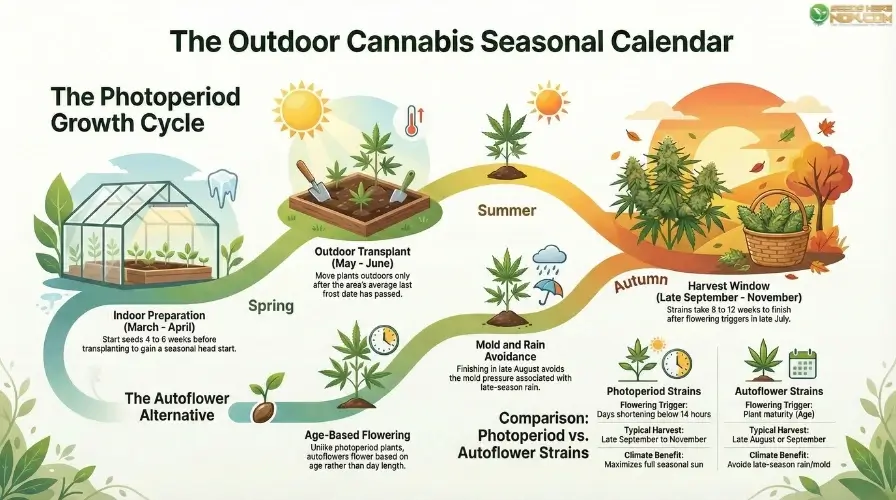
Timing: When To Plant Outdoor Cannabis
Outdoor cannabis timing is driven by two factors: frost risk and light cycle.
Transplant date: After your area’s last average frost date. Starting seeds indoors 4 to 6 weeks before transplant gives you a head start on the season. In the continental U.S., this typically means indoor starts in March or April and outdoor transplant in May or June. USDA plant hardiness zone maps and local last-frost data are the reference points.
Photoperiod flowering trigger: Photoperiod cannabis begins flowering when days shorten below approximately 14 hours of light. In most of the U.S., this occurs in late July or early August. From that point, most strains take 8 to 12 weeks to finish, meaning harvest falls in late September through November, depending on latitude and strain.
Autoflowers outdoors are not subject to the light cycle constraint—they flower based on age. This allows multiple outdoor cycles per season in warm climates, or a single summer grow in short-season climates. Autoflowers planted in late May in the U.S. typically finish in late August or September, avoiding late-season rain and mold pressure that late-flowering photoperiod strains face.
Outdoor Feeding and Watering
Watering: In-ground plants in good soil often need no watering during wet spring months. As summer heat increases and rainfall decreases, plants may need 5 to 15 gallons per plant per week, depending on size, temperature, and soil moisture retention. Feel the soil 3 to 4 inches down—if it’s dry, water. A significant disadvantage of large outdoor plants is irrigation demand: a 10-foot plant in August heat requires a large volume of water. Drip irrigation systems eliminate the need for daily watering. See our guide to cannabis irrigation for system design options.
Feeding: In-ground plants in well-amended soil require less supplemental feeding than indoor or container plants. A top-dressing of compost or worm castings at the start of veg and again at the start of flower is often sufficient in good native soil. Outdoor container plants need a complete feeding program similar to that for indoor container growing. See our cannabis nutrient schedule for seasonal feeding guidelines.
Managing Pests and Disease Outdoors
The outdoor environment provides both helpers and threats. Beneficial insects—ladybugs, lacewings, predatory wasps—naturally suppress aphids, spider mites, and caterpillars when the environment supports them. A diverse garden with flowering plants attracts beneficial populations.
Primary outdoor pests: Aphids, spider mites (in hot, dry conditions), caterpillars/budworms (especially damaging in flower), and fungus gnats in overwatered soil. Organic management options—neem oil, insecticidal soap, BT (Bacillus thuringiensis) for caterpillars—work well when applied early and preventatively.
Mold and fungal disease: Botrytis (bud rot) and powdery mildew are the most serious outdoor cannabis diseases. Botrytis thrives in cool, wet, late-season conditions—exactly the conditions that coincide with harvest time in many climates. Mold-resistant strain selection is the first line of defense; regular scouting and immediate removal of infected material is the second. See protecting cannabis plants from bad weather for strategies that reduce late-season mold risk.
Harvest Timing for Outdoor Plants
Outdoor harvest timing is identical in principle to indoor—trichome maturity is the primary indicator—but outdoor plants face the additional pressure of weather. Growers in wet-autumn climates sometimes harvest slightly early to avoid mold rather than waiting for peak trichome maturity. This is a judgment call: the expected weather window vs. the potency gain from waiting another week.
For detailed harvest timing guidance, see our Complete Cannabis Harvest and Cure Guide.
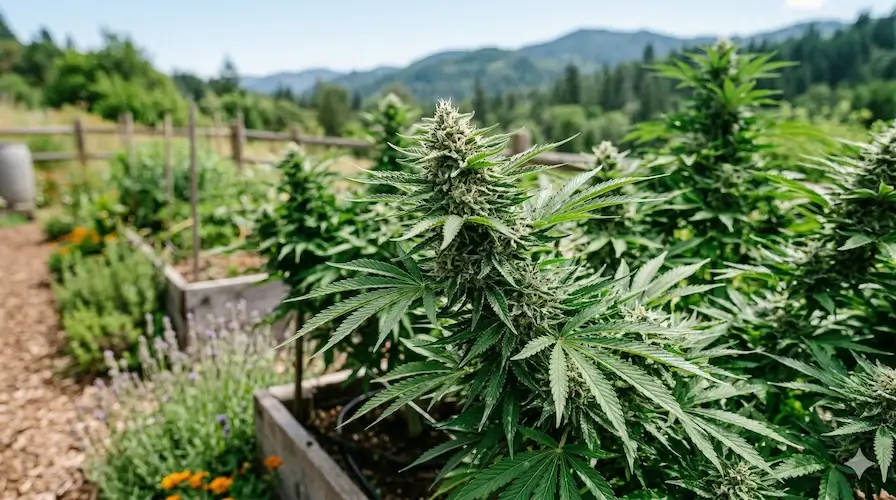
Best Outdoor Cannabis Strains at Seeds Here Now
Genetics matter more outdoors than most growers expect. Indoor growing compensates for mediocre genetics through environmental control. Outdoors, the plant runs on sun and soil, and its genetic potential is fully exposed. These varieties have demonstrated consistent outdoor performance across a range of U.S. climates—selected for structure, mold resistance, finish time, and real grower results.
Durban Poison
South African landrace—a pure sativa that evolved under outdoor conditions and performs best in them. Sweet anise terpenes, energetic cerebral high, and finish time that’s fast for a pure sativa (8 to 9 weeks). Excellent disease resistance. Among the best outdoor sativas for U.S. climates. Full Durban Poison review.
Northern Lights
Compact, fast-finishing indica (7 to 8 weeks) with excellent mold resistance and adaptability to varied climates. One of the most popular outdoor strains in the Pacific Northwest for good reason. Low odor during growth, manageable height, consistently reliable harvest. Northern Lights review here.
Blue Dream
Sativa-dominant hybrid that thrives outdoors in warm climates and produces exceptional yields when given space. Blueberry x Haze genetics that respond well to organic soil conditions, producing quality that rivals indoor results when the season cooperates. Blue Dream review.
White Widow
Dutch classic with outdoor heritage—White Widow’s Brazilian sativa genetics give it natural outdoor vigor. Dense resin production, good mold resistance for a dense-budded strain, and 8 to 9 weeks of flowering. An excellent outdoor producer across a wide range of climates. White Widow review.
Frequently Asked Questions
When should I plant cannabis seeds outdoors?
After your last frost date, once nighttime temperatures consistently stay above 50°F. In most of the U.S., this means May or early June for outdoor transplanting. Starting seeds indoors in March or April gives you a head start on veg time.
How tall do outdoor cannabis plants grow?
Highly strain-dependent. Indica-dominant varieties stay 3 to 6 feet. Sativa-dominant varieties can reach 12 to 14 feet or more in a full outdoor season with good soil. Autoflowers typically stay under 4 feet regardless of outdoor conditions.
Can I grow cannabis outdoors in a legal state with any climate?
Technically, yes, with appropriate strain selection. Autoflowers and fast-finishing photoperiod strains work in short-season climates (Zone 4 to 5). Mold-resistant, open-structure strains work in humid southeastern climates. Hot desert climates require heat-tolerant genetics and careful water management. Genetics is the answer to most climate challenges.
Do outdoor plants need any nutrients beyond good soil?
In very fertile, well-amended in-ground soil, some strains finish a full season without supplemental feeding. Most plants benefit from a mid-season organic top-dress and a phosphorus boost at flower onset. Container outdoor plants always need supplemental feeding. A simple organic fertilizer regimen is sufficient for most outdoor grows.
How do I prevent my outdoor plants from being pollinated by male plants?
If growing feminized seeds, this isn’t a risk from your own plants. Wild-growing hemp or feral cannabis in your region can pollinate outdoor plants if pollen travels on the wind. If you’re growing in an area with significant feral cannabis populations, this is worth monitoring. Regular scouting for seeds in developing buds is the best detection method.
Can I grow cannabis outdoors in a pot instead of in the ground?
Yes—and for growers who need portability or don’t want to commit to in-ground planting, large containers work well. Use a minimum of 25-gallon containers for full-season plants (50-gallon or larger for strains that want to grow very large). Container plants require more water and feeding than in-ground plants, but offer greater flexibility for moving or adjusting spacing.
When should I harvest outdoor cannabis?
When trichomes reach desired maturity (70% to 90% cloudy for most users, with some amber). Most outdoor photoperiod strains in the U.S. harvest between late September and early November. Autoflowers typically finish 60 to 90 days from seed, allowing a summer harvest. Watch weather forecasts—harvesting before a prolonged wet period is often the right call, even if plants could use another week.
Shop Outdoor-Ready Genetics
Seeds Here Now carries a full selection of outdoor-tested genetics—including landrace strains, mold-resistant hybrids, large-scale outdoor producers, and autoflowers suited to every U.S. climate zone.