


Growing cannabis indoors is one of the most effective ways to produce high-quality flower with consistency, precision, and control. Unlike outdoor cultivation, where environmental conditions are constantly changing, indoor growing allows you to create a stable ecosystem tailored to the plant’s needs.
However, that control comes with responsibility. When you grow indoors, you are replacing nature entirely. Every variable—light, temperature, humidity, airflow, water, and nutrients—must be managed intentionally. The difference between an average harvest and an exceptional one often comes down to how well you understand the why behind each of these factors.
This guide is designed to serve as a complete reference for indoor growers, breaking down not only how to grow cannabis indoors but also how to approach the process to achieve consistent success.
Why Grow Cannabis Indoors?
Indoor cultivation exists primarily to eliminate unpredictability. Cannabis is highly sensitive to its environment, and even small fluctuations in external conditions can impact growth, yield, and chemical composition. Outdoors, these fluctuations are unavoidable. Indoors, they are entirely within your control.
This level of control allows growers to optimize conditions for specific outcomes. Stable environments support more efficient photosynthesis, consistent nutrient uptake, and improved flower development. As a result, indoor-grown cannabis often exhibits superior terpene profiles, tighter bud structure, and higher cannabinoid concentrations.
Indoor growing also gives you the ability to:
- Grow year-round regardless of climate
- Control flowering cycles with light timing
- Reduce exposure to pests and contaminants
At the same time, indoor growing removes the buffering effect of nature. When something goes wrong outdoors, environmental variation can sometimes compensate. Indoors, problems tend to compound if not addressed. This is why indoor cultivation requires a systems-based mindset rather than a checklist approach.
Understanding the Cannabis Lifecycle
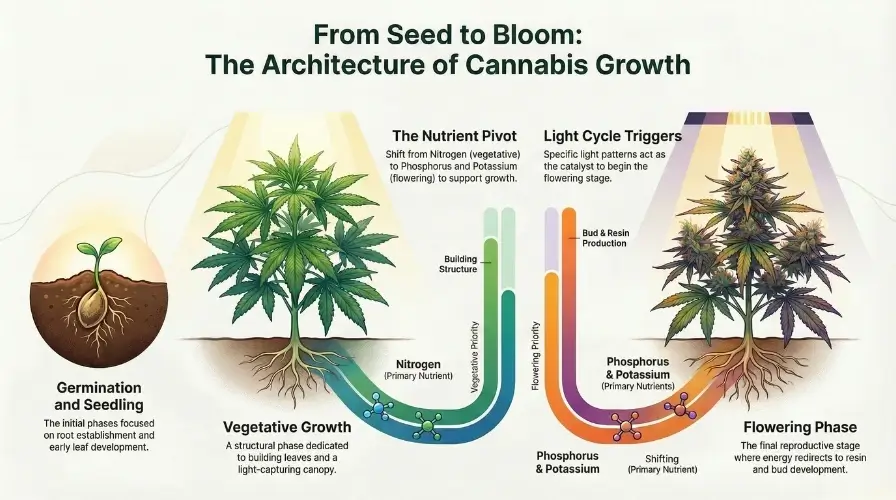
Cannabis growth follows a defined biological progression, and each stage in the lifecycle reflects a shift in the plant’s priorities.
The plant moves through four primary stages:
- Germination (root establishment)
- Seedling (early leaf development)
- Vegetative growth (structure and canopy building)
- Flowering (reproductive phase and bud development)
During vegetative growth, the plant focuses on building its structure—leaves and branches that capture light. In flowering, it redirects energy toward producing buds and resin.
This shift underscores the need for environmental adjustments. For example:
- Nitrogen supports vegetative growth
- Phosphorus and potassium support flowering
- Light cycles determine when flowering begins
The key idea is that each stage has a purpose, and your role is to support that purpose—not treat the plant the same from start to finish.
Choosing Seeds or Clones
The starting point of any grow is genetics. Even a perfectly optimized environment cannot overcome weak or unstable genetics. As such, understanding the differences between seeds and clones is essential.
Seeds provide variability. Each plant is unique, which allows growers to discover exceptional phenotypes. This is valuable if you want to explore different expressions within a strain.
Clones, on the other hand, provide consistency. Because they are genetically identical to the mother plant, they offer predictable results in terms of growth, yield, and effects.
The decision often comes down to your goal:
- Choose seeds if you want diversity and exploration
- Choose clones if you want uniformity and efficiency
Both approaches can produce excellent results when managed properly.
Setting Up Your Indoor Grow Space
Your grow space is not just a container—it is a controlled environment where multiple variables interact continuously.
Lighting generates heat. Heat affects humidity. Humidity influences transpiration. Transpiration drives nutrient uptake. Because of this, every component of your setup should be considered in relation to the others.
A well-designed grow space should allow you to:
- Maintain stable temperature and humidity
- Distribute light evenly across the canopy
- Provide consistent airflow
- Prevent stagnant air pockets
Grow tents are often preferred because they simplify these variables. Their reflective interiors improve light efficiency, and their enclosed structure makes environmental control easier.
The key principle is to think of your grow space as an ecosystem rather than a static setup.
Lighting: The Primary Driver of Growth
Light is the most important factor in indoor cannabis cultivation because it fuels photosynthesis and controls plant behavior.
Cannabis responds to both light intensity and duration. Intensity determines how much energy the plant can convert into growth, while duration determines whether the plant remains in vegetative growth or transitions into flowering.
Too little light results in weak, stretched plants. Too much light can cause stress, including bleaching and reduced efficiency.
Modern LED systems are widely used because they offer:
- High energy efficiency
- Adjustable intensity
- Full-spectrum output
The goal is not to provide maximum light, but optimal light. Matching intensity to plant health and growth stage yields better results than simply increasing output.
Temperature and Humidity: Regulating Plant Function
Temperature and humidity work together to regulate transpiration, the movement of water and nutrients through the plant.
Temperature influences metabolic activity. Warmer conditions increase growth rates, while cooler conditions slow them down. However, extremes in either direction can create stress.
Humidity determines how easily water evaporates from the leaves. If the humidity is too low, the plant loses water too quickly. If it is too high, water movement slows, reducing nutrient transport.
A balanced environment supports steady transpiration, which allows the plant to function efficiently. This balance is one of the most important factors in healthy growth.
Airflow and Ventilation
Airflow supports gas exchange, temperature regulation, and overall plant health.
Cannabis requires a steady supply of carbon dioxide for photosynthesis. Without proper airflow, CO₂ becomes depleted, and growth slows.
At the same time, stagnant air allows heat and humidity to build up unevenly, increasing the risk of mold and disease.
A proper ventilation system should:
- Exchange stale air with fresh air
- Circulate air evenly throughout the canopy
- Prevent hot or humid pockets
Air movement should be gentle and consistent, allowing leaves to move slightly without being stressed.
Choosing a Growing Medium
The growing medium determines how roots interact with water, oxygen, and nutrients.
Soil is often the most forgiving option because it contains organic matter and microbes that buffer nutrient availability. This makes it easier for beginners to manage.
Coco coir offers more control and faster growth due to improved aeration, but it requires more precise feeding.
Hydroponic systems provide direct access to nutrients, allowing for rapid growth and high yields. However, they demand careful monitoring and experience.
Each medium represents a trade-off between control and forgiveness.
Watering: Supporting Root Health
Watering is not about frequency—it is about creating the right conditions for roots.
Roots require both water and oxygen. When the medium is constantly saturated, oxygen levels drop, which can impair root function.
Healthy watering follows a cycle:
- Water thoroughly
- Allow the medium to dry partially
- Reintroduce oxygen into the root zone
This cycle encourages root expansion and improves nutrient uptake.
Common signs of overwatering include persistent drooping, slow growth, and heavy, waterlogged containers. In most cases, allowing the medium to dry slightly before watering again resolves these issues.
Nutrients and Feeding
Cannabis requires a range of nutrients to support growth, but more is not always better.
The primary macronutrients are:
- Nitrogen (supports vegetative growth)
- Phosphorus (supports roots and flowers)
- Potassium (supports overall plant function)
Overfeeding can lead to salt buildup, root stress, and nutrient lockout. This occurs when the plant is unable to absorb nutrients despite their presence.
The most effective feeding strategy is gradual. Start with lower concentrations and increase as the plant demonstrates the ability to use those nutrients effectively.
Training Techniques and Canopy Management
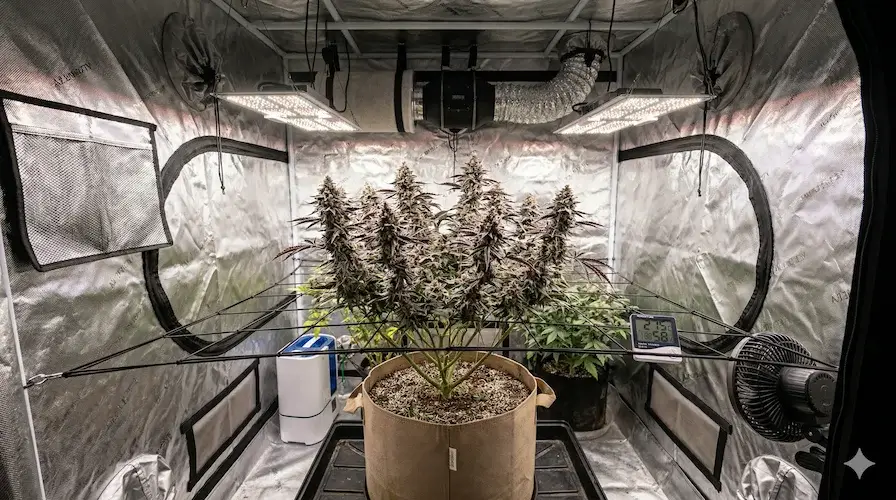
Indoor growing requires efficient use of space and light. Training techniques are used to shape the plant for optimal light exposure.
Cannabis naturally grows vertically, but indoor lighting works best with a flat, even canopy.
Training methods such as topping, low-stress training, and screen-based approaches help:
- Redistribute growth hormones
- Increase the number of productive bud sites
- Improve light penetration
The goal is to create a canopy where all parts of the plant receive adequate light.
Transitioning to Flowering
The transition to flowering is triggered by changing the light cycle to 12 hours of light and 12 hours of uninterrupted darkness.
This signals the plant to begin its reproductive phase.
During this transition, the plant undergoes rapid vertical growth, often referred to as the ‘stretch’. This phase determines the final structure of the plant and the placement of bud sites.
Managing this stage carefully ensures that the plant develops a structure capable of supporting high yields.
Managing the Flowering Stage
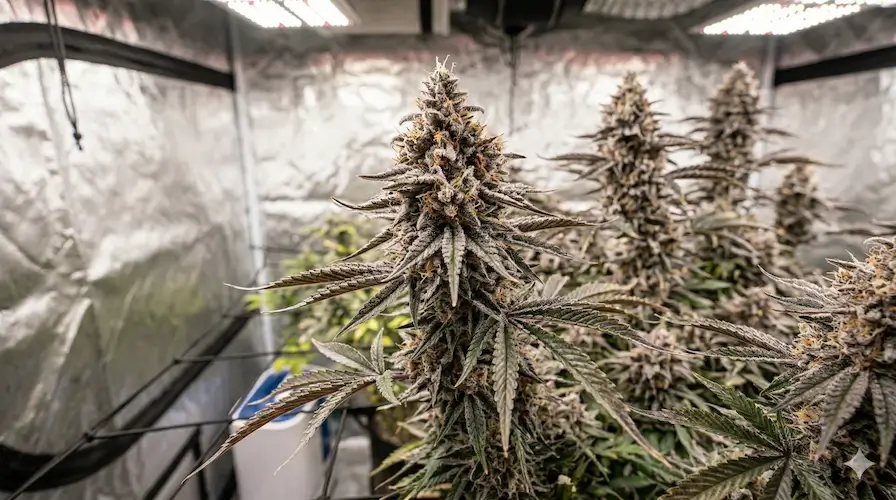
The flowering stage is when the quality of the buds is determined.
Environmental control becomes even more important. Dense buds are more susceptible to moisture-related issues, so humidity levels should be reduced to minimize the risk of mold.
At the same time, nutrient requirements shift toward supporting bud development rather than leaf growth.
Key priorities during flowering include:
- Maintaining stable environmental conditions
- Ensuring proper airflow
- Avoiding excessive nutrient buildup
Consistency during this stage leads to better flavor, potency, and overall quality.
Harvesting at the Right Time
Harvest timing directly affects the final experience.
Trichomes provide visual indicators of maturity:
- Clear trichomes indicate the plant is not yet ready
- Milky trichomes represent peak cannabinoid levels
- Amber trichomes indicate a more sedative effect
Harvesting is not just about timing—it is about selecting the desired outcome.
Drying and Curing
Drying and curing are essential for preserving quality after harvest.
Drying should occur slowly in a controlled environment to prevent terpene loss and avoid harsh smoke. Once dried, the buds are cured in sealed containers to allow internal processes to stabilize.
Proper curing improves:
- Flavor and aroma
- Smoothness of smoke
- Overall perceived potency
This stage is often overlooked, but it plays a major role in the final quality of the product.
Common Indoor Growing Mistakes
Many indoor growing issues stem from overcorrection rather than neglect.
Common mistakes include:
- Overwatering the root zone
- Overfeeding nutrients
- Using excessive light intensity
- Allowing environmental fluctuations
- Poor airflow and ventilation
In most cases, simplifying the approach and focusing on stability resolves these problems.
Advanced Insight: Thinking in Systems
The most important skill in indoor growing is the ability to think in systems.
Every variable affects another. Light influences temperature. Temperature affects humidity. Humidity controls transpiration. Transpiration drives nutrient uptake.
Understanding these relationships allows you to diagnose problems more effectively and make informed adjustments.
Rather than reacting to symptoms, experienced growers identify the underlying cause within the system.
Final Thoughts
Growing cannabis indoors is a process of refinement. Success comes from understanding how the plant interacts with its environment and making adjustments that support those interactions.
Focus on stability, balance, and observation. When these elements are aligned, the plant can express its full genetic potential.
Indoor cultivation is not about forcing growth—it is about removing limitations.
Looking for more expert grow guides? Check out the Seeds Here Now blog.
Frequently Asked Questions
How long does it take to grow cannabis indoors?
Most indoor grows take between three and five months from seed to harvest, depending on strain and vegetative time.
What is the best light for indoor cannabis?
Full-spectrum LED lights are currently the most efficient and widely used option.
How often should I water cannabis plants?
Water based on the dryness of the medium rather than a fixed schedule. This ensures proper root health.
How much yield can I expect indoors?
Yield varies depending on genetics, environment, and experience. Many growers measure efficiency in grams per watt.
Is indoor growing better than outdoor?
Indoor growing offers greater control and consistency, while outdoor growing can yield larger plants at a lower cost.