


Most beginner grow guides are written by people who have forgotten what it’s like to be a beginner. They assume familiarity with terms that need defining, skip steps that seem obvious after 10 years of growing but aren’t, and bury the practical information under so much theory that a new grower gives up before the first seed hits the soil.
This guide doesn’t do that. It covers what you actually need to know to grow your first cannabis plant successfully—from choosing seeds through harvest—with the right amount of detail at each stage. Not everything. The right things.
Why Growing Your Own Is Worth It
Control. That’s the primary reason experienced cannabis users start growing their own.
When you grow your own cannabis, you know exactly what touched the plant during its life—what nutrients, what pesticides (if any), what water source, what curing conditions. Dispensary and delivery products carry no such transparency. You’re trusting the operator, the lab, and the supply chain.
Cost is the second reason. A single quality cannabis plant grown to completion can produce 2 to 4 ounces indoors, more outdoors. At current dispensary prices, that represents significant savings compared to buying the equivalent quantity. After initial equipment investment, the cost per gram drops dramatically with each subsequent grow.
The third reason—and the one most experienced growers cite as primary after a few years—is the craft itself. Cannabis cultivation is genuinely interesting. It involves biology, chemistry, environmental management, and selection. It’s a skill that compounds. Your fifth grow will be meaningfully better than your first, not because you followed different instructions but because you learned to read the plant.
Understanding the Cannabis Life Cycle
Cannabis is an annual plant. It completes its full life cycle—from seed to harvest—within a single growing season. Understanding the stages tells you what the plant needs at each stage and helps prevent the most common mistakes.
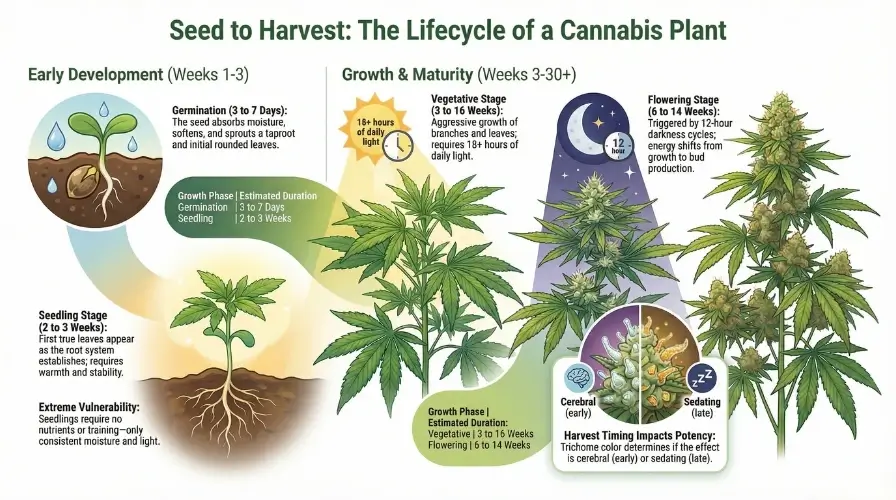
Germination (3 to 7 days). The seed absorbs moisture, the seed coat softens, and a taproot emerges. The seedling pushes through the growing medium and produces its first two rounded leaves (cotyledons). See the full Cannabis Germination Guide for detailed methods and troubleshooting.
Seedling Stage (2 to 3 weeks). The cotyledons give way to the first true cannabis leaves—initially single-bladed, then progressively more fingered as the plant matures. The root system is establishing itself. This is the most vulnerable stage: seedlings need consistent moisture, adequate light, and warmth, but very little else. No nutrients yet. No training yet. Just stable conditions and patience. Read more in our cannabis seedling stage guide.
Vegetative Stage (3 to 16 weeks, depending on strain and intent). The plant grows aggressively, developing a branching structure, root mass, and leaf area to support its flower production. Photoperiod strains remain in veg as long as they receive 18+ hours of light per day. This is the stage for training, topping, and shaping the plant’s structure. Nutrient needs increase substantially.
Flowering Stage (6 to 14 weeks, depending on strain). Triggered by a shift to 12 hours of light and 12 hours of uninterrupted darkness (for photoperiod strains), or by age in autoflowers. Bud sites develop, swell, and accumulate trichomes. Terpene production intensifies. The plant shifts its energy from growth to reproduction. Nutrient needs shift from nitrogen-heavy to phosphorus and potassium-heavy.
Harvest. Timing harvest correctly—evaluating trichome color and pistil development—determines the potency, effect, and quality of what you smoke. Early harvest produces more cerebral, less sedating effects. Late harvest produces more sedating, CBN-heavy effects. The sweet spot varies by strain and personal preference. See the full cannabis plant life cycle guide for a detailed stage-by-stage breakdown.
Your First Critical Decision: Choosing Seeds
Seed choice is the most important decision a beginner makes, and most beginners make it wrong—they chase the most potent or most famous strain rather than the most appropriate one for their first grow.
What to look for in your first strain:
Resilience. Some strains punish mistakes heavily. Northern Lights, Blueberry, and White Widow are not. These are forgiving genetics that handle beginner errors—inconsistent watering, occasional nutrient miscalculations, imperfect temperature control—without catastrophic consequences.
Reasonable flowering time. A 14-week flowering time is a long time to wait as a beginner, and long-flowering strains are harder to manage through their full cycle. Aim for strains that flower in 8 to 9 weeks for your first run.
Seed type appropriate for your goals. For most beginners, feminized photoperiod or feminized autoflower seeds are the right choice. Feminized seeds eliminate male plant management. Autoflowers add the advantage of not requiring light cycle changes to trigger flowering—they switch on their own after 3 to 4 weeks. See our guides on feminized seeds and autoflower seeds for the full picture.
For specific strain recommendations: the best cannabis seeds for beginners and best cannabis strains for beginners are both worth reading before making your selection.
Indoor vs. Outdoor: Which Is Right for You?
Outdoor growing is simpler, cheaper, and produces larger plants—but it requires the right climate, adequate space, and reasonable privacy. Outdoor cannabis in warm climates (roughly Zone 7 and warmer for the continental U.S.) produces plants that can reach 12 feet and yields measured in pounds. The primary inputs are soil, water, and sunlight. The primary risks are weather, pests, and detection. Outdoor harvest typically happens in late September through October, depending on latitude and strain.
Indoor growing gives you complete environmental control regardless of geography or climate. You can grow year-round, run multiple cycles per year, and dial in conditions to an extent that outdoor growing can’t match. The tradeoffs: equipment cost, ongoing electricity expense, and more active management. A basic indoor setup runs $300 to $600 to get started; a well-equipped 4×4 tent setup runs $800 to $1,500. See our beginner’s guide to indoor growing for the full equipment and setup breakdown.
Greenhouse growing is the middle path—free sunlight, partial climate control, year-round growing in some climates. It requires more initial investment than outdoor but less than a full indoor setup and produces results that often surpass either. For gardeners with space, a greenhouse is frequently the best long-term option. See our greenhouse cannabis cultivation guide.
Essential Indoor Growing Equipment
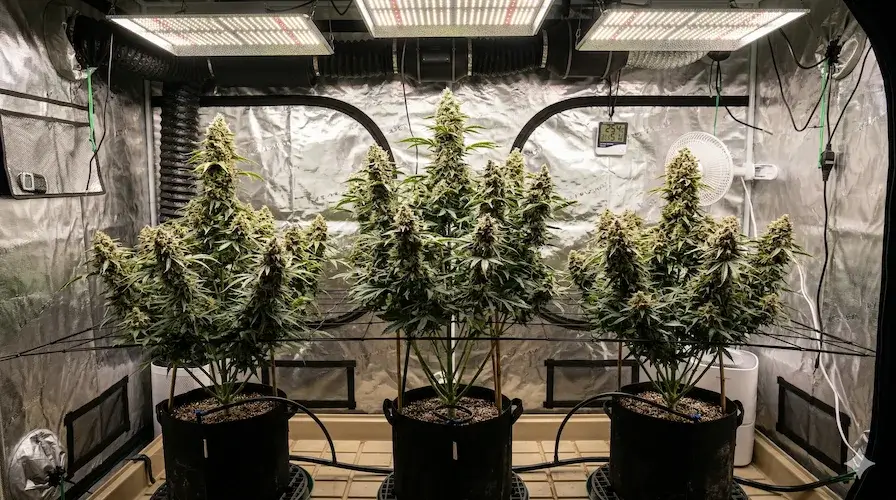
You do not need expensive equipment for your first grow. You need adequate equipment. Here’s the minimum viable indoor setup:
Grow tent. A 2×2 or 2×4 tent for one to two plants. Controls light leakage, reduces odor to some degree, and creates a defined growing environment you can manage. Brands like AC Infinity, Vivosun, and Mars Hydro offer reliable tents priced from $60 to $120.
LED grow light. Modern full-spectrum LED panels have made HID (HPS and MH) lights largely obsolete for small grows. A quality 100W to 200W LED will adequately cover a 2×2 to 2×4 area. Quantum board designs (like those from Mars Hydro or Spider Farmer) provide even coverage and run cool. Budget $100 to $200 for a light that works well. See our grow lights guide for a detailed comparison of types and brands.
Ventilation. An inline fan with a carbon filter, connected to ducting that vents air outside the tent. Airflow prevents mold, manages temperature and humidity, and—when running a carbon filter—controls odor. AC Infinity makes reliable inline fans with built-in controllers. Budget $100 to $150 for fan, filter, and ducting.
Growing medium. For beginners, a good cannabis-specific potting soil eliminates most nutrient complexity. Fox Farm Ocean Forest or similar pre-amended soils provide enough nutrition for the first 4 to 6 weeks without additional feeding. This removes the biggest source of beginner errors: overfeeding.
Containers. Fabric pots (also called smart pots) are the standard recommendation for beginners because they prevent overwatering—roots hit air at the fabric wall and self-prune rather than becoming rootbound. 3-gallon fabric pots work for one plant in a 2×2. 5-gallon for larger plants or a 2×4.
Basic monitoring tools. A digital thermometer and hygrometer ($15 to $20) to monitor temperature and humidity. A pH meter ($30 to $60) to check water and soil pH—this is non-optional if you want to avoid nutrient lockout. A TDS meter for checking nutrient concentration is useful, but not required for beginners using amended soil. Total tool investment: $50 to $80. Do not skip the pH meter. It prevents the most common nutrient problems before they start.
The Vegetative Stage: What You’re Doing and Why
Vegetative growth is when you build the structure on which your harvest depends. A bigger, better-developed plant going into flower produces more bud sites and a higher yield than a small, underdeveloped plant. Veg time is the investment period.
Lighting for veg: 18 hours of light per day, 6 hours of darkness. This mimics long summer days and keeps photoperiod plants in vegetative growth. Autoflowers don’t need a light schedule change—they can run 18/6 or 20/4 throughout their entire life.
Nutrients for veg: Cannabis in vegetative growth needs nitrogen (for leaf and stem development), phosphorus (for root development), and potassium (for overall plant health), with nitrogen as the dominant need. If you’re growing in pre-amended soil, you may not need to add anything until week 4 or 5. See our cannabis nutrient schedule guide.
Training in veg: Low-stress training (LST) involves bending and tying branches to create a more horizontal, even canopy. It increases light penetration and produces more bud sites than an untrained, vertical plant. Topping—cutting the main growing tip to create two main colas—doubles the top bud sites and encourages bushier growth. Both are beginner-accessible techniques. Full training technique guide.
Watering in veg: Water when the top inch of soil dries out. Lift the pot—a light pot needs water, a heavy pot doesn’t. Overwatering is the most common beginner mistake in veg. Wet, poorly drained soil suffocates roots and stunts growth. See our cannabis irrigation guide for more on watering technique and frequency.
The Flowering Stage: What Changes and Why
Flowering is triggered in photoperiod plants by switching to a 12/12 light cycle (12 hours on, 12 hours of uninterrupted darkness). The darkness must be complete—any light leaks can interrupt the flowering trigger and cause stress.
During the first 2 weeks of flowering, the plant “stretches”—growing rapidly in height and branching as it prepares its bud sites. Expect a 50% to 100% increase in height from mid-veg size during this stretch. Plan your canopy height before flipping to 12/12.
By weeks 3 to 4, bud sites are clearly defined and beginning to swell. White pistil hairs cover the developing flowers. Terpene production begins, and the smell becomes pronounced. This is when carbon filtration becomes important if odor is a concern.
Weeks 5 through 8 (or 5 through 10+ for longer-flowering strains) are the bulk of flower development. Buds swell, trichomes develop from clear to cloudy to amber, and the plant’s nutritional needs shift. Reduce nitrogen, increase phosphorus and potassium.
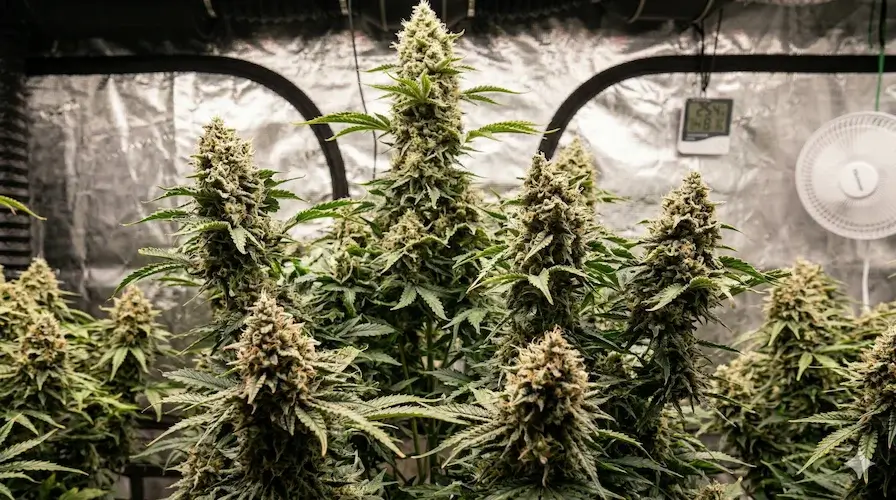
Harvest timing is determined by trichome inspection with a jeweler’s loupe or digital microscope. Clear trichomes mean the plant is not ready. Cloudy (milky) trichomes indicate peak THC. Amber trichomes indicate THC is degrading to CBN, producing more sedating effects. Most growers harvest at 70% to 90% cloudy with 10% to 30% amber.
Seven Mistakes That Kill First Grows
Overwatering. The most common beginner error. Cannabis roots need oxygen. Saturated soil deprives them of it. Water less frequently than feels right. The plant should look slightly dry before it gets water again.
Overfertilizing. More nutrients do not equal more buds. Nutrient burn—dark tips on leaves that curl downward—is the signature of too much fertilizer. Start at 50% of the manufacturer’s recommended dose and work up based on plant response.
Wrong pH. Cannabis takes up nutrients within a specific pH range: 6.0 to 7.0 in soil and 5.5 to 6.5 in hydroponics. Outside this range, nutrients are present but inaccessible to the plant—nutrient lockout. A $30 pH meter eliminates this problem entirely. It is the most underutilized beginner tool.
Insufficient light. Stretchy, tall plants with wide internodal spacing are usually suffering from light deficiency. Cannabis wants intense light—especially during flowering. If your plants are leaning toward the light or growing excessively tall, you don’t have enough.
Harvesting too early. Impatience at harvest is expensive. A cannabis plant harvested 2 weeks early loses 30% to 40% of its potential potency and yield. Wait for the trichomes to tell you it’s time.
Skipping the cure. Harvest is not the end. Proper drying and curing develop the terpene profile, improve smoothness, and prevent mold. Rush this step, and the smoke will be harsh, the smell will be hay-like, and the quality won’t reflect what you grew.
Poor genetics. No amount of technique salvages fundamentally mediocre genetics. Buy from reputable breeders with known genetic lines. The seed cost is a small fraction of the total investment in a grow.
Frequently Asked Questions
How long does it take to grow cannabis from seed to harvest?
Autoflower strains: 60 to 90 days from seed, including flowering. Photoperiod strains: 4 to 8 weeks of vegetative growth followed by 8 to 14 weeks of flowering, for a total of 3 to 6 months. Outdoor photoperiod plants typically harvest in late September or October.
How much cannabis does one plant produce?
Indoors: 1 to 4 ounces per plant for a beginner, more for experienced growers with good setups and technique. Outdoors: 3 to 16 ounces per plant, depending on climate, genetics, grow space, and technique. These are realistic ranges, not marketing claims.
Do I need a tent to grow indoors?
Not technically, but practically yes. A grow tent controls light leakage, concentrates light on your plants, makes ventilation and carbon filtration easier, and confines the grow to a defined space. It’s one of the best investments in a beginner setup.
Can I grow cannabis in a closet?
Yes. Closets work well for small grows. The main considerations are adequate lighting, ventilation (air in, air out, carbon filtration for odor), and temperature management. A 2×2 or 2×4 tent in a closet is a common and effective beginner setup.
What’s the easiest cannabis strain for beginners?
Northern Lights, White Widow, Blueberry, and autoflower varieties in general are regularly recommended for beginners because they tolerate mistakes and don’t require advanced technique to produce decent results. See our beginner strain guide for a full list with growing notes.
How much does it cost to set up an indoor grow?
A functional beginner indoor setup (tent, light, ventilation, basic supplies) runs $400 to $800 for initial investment. Ongoing costs include electricity (typically $30 to $80 per month for a small setup), nutrients, and seeds. After the first grow, per-grow costs drop substantially.
Is it difficult to grow cannabis?
The fundamentals are accessible to anyone who can maintain a houseplant. The advanced techniques—high-yield training, hydroponic systems, selective breeding—take years to master. Most beginners produce smokable cannabis on their first try. Most beginners also make meaningful improvements by their third try. It’s a skill curve, not a cliff.
Ready To Start Growing?
Everything starts with genetics. Get your seeds right before you invest in equipment, and everything that follows goes better. Seeds Here Now carries over 2,000 strains from verified breeders—including the beginner-friendly varieties that make the first grow succeed instead of teaching you why everything went wrong.