


Unearthing the Past: Heirloom & Landrace Strains

Landrace strains are a treasure trove of old genetics: traditional varieties that adapted to specific regions over centuries. Heirloom strains are their preserved descendants, kept true after leaving home.
I’m James Bean, founder of Seeds Here Now since 2010.
Seeds Here Now sells authentic breeder packs to adults 21+. We do not provide growing instructions, and nothing here is a medical claim.
1. Landrace Strains Are Shaped by Place
A landrace adapted to one region over many generations, shaped by local climate and by the farmers who saved its seed. That is why lines from mountains, deserts and tropics look and smell so different.
Natural Selection and Farmer Selection
Two forces shape landrace strains. The first is the environment: plants that cope well with a region’s altitude, rainfall, temperature and season leave more seed behind. The second is people: farmers save seed from the plants they value most, whether for fiber, seed, resin or aroma.
Over many generations, those two forces work together. The result is a line that fits its region closely and reflects what local people wanted from the plant. That is why two landrace strains from neighboring valleys can still differ in noticeable ways.
How Long a Landrace Takes to Form
There is no fixed number of years that turns a population into a landrace. Most accounts describe many generations of local keeping, often over decades or centuries, with little outside genetic input.
For buyers, the practical point is this: a true landrace has a long, local history. A line that arrived in a region recently, or that has been crossed heavily with imported hybrids, is better described another way.
Fiber, Seed and Resin: Why People Kept Cannabis
For most of its history, cannabis was kept for practical reasons. In many regions it was grown for fiber, used in rope, cloth and paper. In others, its seed was a food. In the mountains of Central and South Asia, it was kept above all for resin.
Those different uses pulled landrace strains in different directions. Fiber lines favored tall stems, seed lines favored heavy seed, and resin lines favored compact, frosty plants. The landrace strains buyers know today mostly come from regions where resin or aroma were the priority.
The Role of Isolation
Isolation is what lets a landrace stay distinct. Mountain valleys, islands and remote farming districts kept local lines apart from outside pollen for generations.
That is why so many famous landrace strains come from hard-to-reach places, and why roads, trade and modern travel have put so many of them at risk.
2. Heirloom Strains Have Left Home
An heirloom is a landrace that was carried out of its homeland and preserved elsewhere, often for decades. Heirloom strains keep much of their original character, but slowly adapt to their new place.
| Landrace | Heirloom | |
|---|---|---|
| Where it lives | Its native region | Preserved outside its homeland |
| Shaped by | Local climate and farmers | Original genetics plus a new place |
| Example | Kerala lines in India | Classic Thai or Afghani lines kept abroad |
Heirloom Drift
Once an heirloom leaves its homeland, it starts to change. A new climate favors different plants, and keepers may select for different traits than the original farmers did. Over decades, an heirloom can drift away from the landrace it came from.
That drift is not a flaw. It is part of the heirloom’s history. But it is why buyers treat landrace strains and heirloom strains as related but distinct, and why the keeper’s records matter for both.
Famous Heirloom Journeys
Many of the best-known heirloom strains were carried out of their homelands in the 1960s and 1970s, when travelers brought seed back from Afghanistan, Thailand, Mexico, Colombia and elsewhere. Some of that seed was kept in North America and Europe for decades.
Those kept lines became the raw material for the first stabilized seed lines of the Dutch era, and a few survive today as preserved heirlooms. Our guide to heritage strains covers several of the famous regional names.
Heirloom Strains Kept by American Growers
Some heirloom strains have been kept in the United States since the 1970s, when growers began saving seed from imported landrace stock instead of relying on new imports. Over decades, those kept lines adapted to their new homes.
These American heirlooms are part of the country’s cannabis history, and several fed directly into the first famous American hybrids. Where a keeper can document a line’s history, it is one of the most interesting kinds of heirloom strains to collect.

3. Many Famous Hybrids Come From a Few Landraces
Afghani and Hindu Kush lines are behind many indica hybrids, while Thai and other equatorial lines are behind classic hazes. Read our guide to heritage strains for six famous examples.
Tracing a Modern Strain Back to Landraces
It is a useful exercise to follow a modern strain back through its parents. Take Girl Scout Cookies: it is usually listed as OG Kush x Durban Poison. Durban Poison is a South African landrace line. OG Kush has a debated history, but it is generally placed in the Kush and Afghan-leaning family.
So a Cookies-family dessert strain bought today may carry, a few generations back, both a South African landrace and Central Asian mountain stock. Almost every modern line can be traced the same way, which is why landrace strains matter even to buyers who mostly buy new releases. Read our Girl Scout Cookies strain review and Durban Poison strain review.
Afghan Landraces and the First Indica Hybrids
When Afghan seed reached Western growers in the 1970s, it brought something new: short, broad-leaved, resin-heavy plants from the mountains. Breeders crossed it with Mexican, Colombian and Thai stock to combine resin and structure with brighter aromas.
Skunk #1 and Northern Lights are two of the best-known results. Both sit close to their landrace roots, and both went on to become parents of countless later lines. Our Afghan Kush and Northern Lights reviews cover that branch.
Equatorial Landraces and the Haze Story
Haze is usually traced to equatorial landrace strains from Thailand, Colombia, Mexico and South India, combined by American growers in the 1960s and 1970s. It is famous for a spicy, incense-like aroma that many modern sativa-leaning lines still carry.
Haze shows how heirloom strains become building blocks. The landraces behind it were carried far from home, kept as heirlooms and then combined into a line that shaped decades of breeding.
African Landraces in Modern Breeding
African landrace strains have quietly shaped modern cannabis too. Durban Poison is usually listed as a parent of Girl Scout Cookies, and lines from Malawi, Eswatini and the Congo appear in the background of several classic hybrids.
For buyers, that makes an African landrace pack a direct link to some of the most popular strain families of the last fifteen years.
Indica and Sativa Began With Landraces
The words indica and sativa come from early botanical descriptions. Cannabis sativa was named in the eighteenth century, and the name Cannabis indica was given in 1785 by the French naturalist Lamarck to plants from India that looked different from European hemp.
Over time, growers began using indica for the short, broad-leaved mountain landrace strains of Afghanistan and the Hindu Kush, and sativa for the tall, narrow-leaved equatorial lines. Today the labels are loose and mostly describe ancestry, but they started as a way to tell regional landraces apart.
4. True Landrace Strains Are Becoming Rare
As modern hybrids spread around the world, many traditional regions have mixed outside genetics into their local lines. Pure lines are harder to find every year, which is why preservation work matters. See maintaining genetic diversity in breeding.
Why Hybrids Replace Local Lines
When popular modern hybrids reach a traditional region, farmers sometimes adopt them, and pollen from those hybrids can mix into local lines. Within a few generations, a region’s traditional population can be diluted or lost.
This has happened in many of the places that once produced famous landrace strains. It is the main reason preservation breeders try to collect from remote areas and document exactly where and when their seed was gathered.
Seed Banks and Living Collections
Preserving landrace strains takes two kinds of effort. Stored seed keeps a snapshot of a line at one moment, while living collections, kept by regenerating the line from many plants, keep it in circulation.
Both matter. Stored seed protects against loss, and living collections keep a line available to breeders and buyers. Our article on maintaining genetic diversity explains why that work is so important.
Buyers play a small part in this too. Holding documented packs, stored well and recorded carefully, adds one more safe copy of a line’s history to the world.

5. Breeders Value Them as Building Blocks
Because these lines are distinctive and relatively uniform within their region, breeders use them as building blocks for new lines and to restore traits lost in heavily crossed hybrids.
What Breeders Look For in Landrace Stock
Breeders turn to landrace strains for traits that are hard to find in heavily crossed modern lines: unusual aromas, distinct structures, strong regional character and genetic diversity. A single landrace parent can add a note that no modern hybrid offers.
That is why many respected breeders keep landrace stock in their libraries even when most of their releases are modern hybrids. Our guides to cannabis breeding and top breeding methods cover the basics.
Landrace Crosses vs. Pure Lines
Some packs sold under landrace names are actually crosses between two landraces, or between a landrace and a modern line. These can be interesting in their own right, but they are not pure landrace strains.
Look for wording on the pack. A pure line names one region. A cross names two parents. When the pack is unclear, ask the seller before you buy.
What an IBL Is
IBL stands for inbred line: a line bred within itself over many generations until its seeds are fairly uniform. Some breeders create IBLs from landrace or heirloom stock to make them more consistent.
An IBL from landrace stock is a step away from the original wild diversity, but it can be a useful, stable way to hold a regional line. Buyers should simply know which they are holding.
Landrace, Heirloom, IBL and Hybrid Compared
| Type | Where it comes from | How uniform | Note |
|---|---|---|---|
| Landrace | Kept in its home region for generations | Varied within a regional range | Look for a named region and keeper |
| Heirloom | A landrace preserved outside its homeland | Varied; may drift over time | Look for a documented history |
| IBL | A line bred within itself for many generations | Fairly uniform | A stable way to hold a line |
| Hybrid | A cross of two or more distinct lines | Depends on the breeder | Most modern named strains |
Knowing which of these you hold is the first step in understanding any pack of landrace strains or heirloom strains.
Why Breeder Libraries Keep Old Lines
Many respected breeders keep a library of landrace and heirloom stock alongside their modern work. Those old lines are insurance: if a modern family becomes too narrow, the library holds diversity that can be brought back.
For buyers, a breeder with a documented library is often a good sign. It suggests the breeder values the long history of the plant, not just the latest trend.
6. Most Are Sold as Regular Seeds
Preservationists usually offer these lines as regular seeds to keep the full genetic range of the line intact.
Why Feminized Landraces Are Rare
Feminized seed is made by a process that narrows a line toward selected female plants. That is useful for many modern releases, but it works against the goal of keeping a landrace’s full genetic range.
That is why most preservationists stick with regular seed. If you see a feminized pack labeled as a pure landrace, ask how it was made and from how many plants.
7. Where Authentic Landrace Seed Comes From
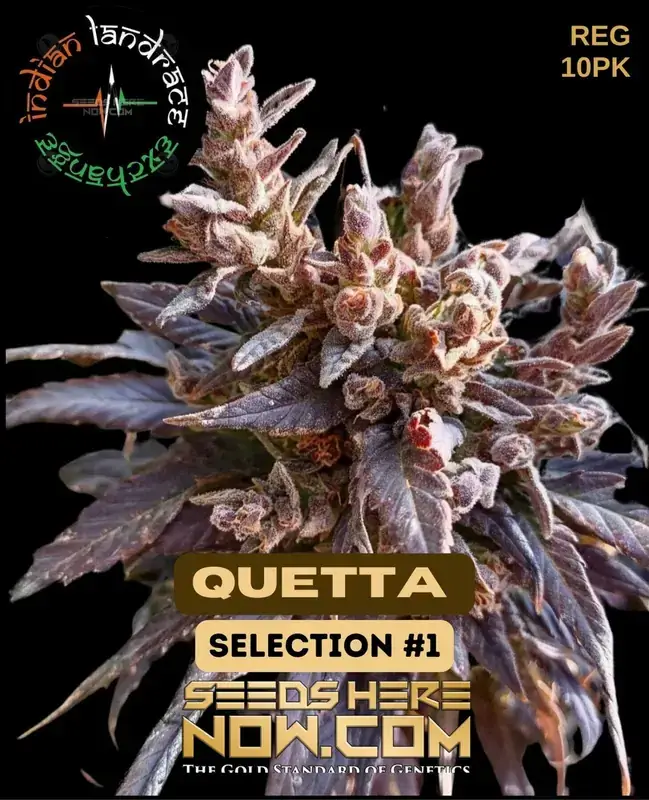
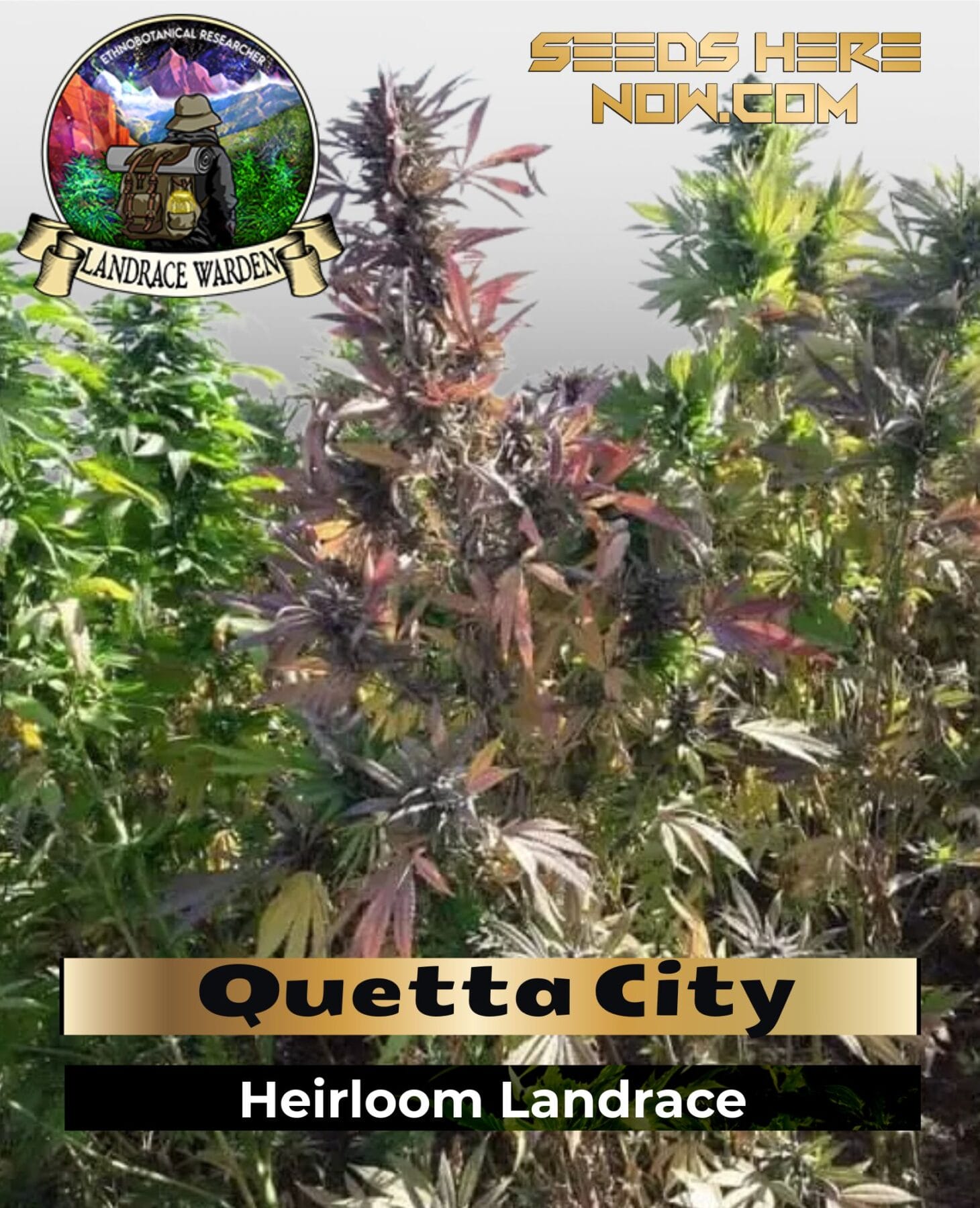
Specialist breeders collect seed in traditional regions and document where it came from. Browse Indian Landrace Exchange (lines such as Urgam Valley and Kerala Gold) and Landrace Warden (Afghan and Pakistani lines such as Quetta City). Read inside the Indian Landrace Exchange.
Pakistani Lines: Quetta City and Gilgit Purple
Landrace Warden works with lines named for places in Pakistan. Quetta is a city in Balochistan, near the Afghan border, in a region long associated with resin-focused mountain cannabis. Gilgit is in the far north, in the high mountain region of Gilgit-Baltistan.
Naming a line for a specific city or valley, rather than a whole country, is a good sign of careful documentation. Browse Landrace Warden for current packs.
What Landrace Names Tell You
Landrace names follow a few patterns. Many use a place, such as Quetta City, Gilgit Purple or Urgam Valley. Others add a trait, such as Gold, Red or Purple, usually describing color. Some add a keeper’s selection label, such as Nawa Elite Selections.
Reading the name this way tells you a lot. A place name points to origin, a trait word points to how the line is usually described, and a selection label tells you the breeder has chosen particular plants from within the line.
Indian Lines: Urgam Valley, Kerala Gold and Nawa
Indian Landrace Exchange documents lines from across India. Urgam Valley lies in the Himalayan state of Uttarakhand, while Kerala Gold comes from the tropical southwest. Its Nawa selections, such as Nawa Elite Selections and Nawa Cotton Candy Foxtail, show the breeder’s selection work within a regional line.
Together they show how much variety one country can hold, from cold Himalayan valleys to a warm, humid coast. Browse Indian Landrace Exchange for current packs.
A Checklist for Landrace and Heirloom Packs
- Does the pack name a specific region, city or valley?
- Does it name the keeper or preservation breeder?
- Is it a pure line, a landrace cross or an IBL?
- Is it regular seed, as most preserved lines are?
- Is it sealed, original breeder packaging from a seller who can explain its source?
Clear answers to these questions separate documented landrace strains and heirloom strains from packs that simply borrow a famous regional name.
Notes and Storage
For each pack, note the line name, the region, the keeper, whether it is a pure line, cross or IBL, the seed type and where and when you bought it. A photo of the sealed pack completes the record.
Store landrace and heirloom seeds sealed in their original packs, somewhere cool, dark and dry, out of reach of children and pets.
If the breeder includes regional notes, photos or a collection story, keep them with the pack. For landrace and heirloom lines, that context is often as valuable as the seeds, because it records where the line came from and how it was kept.
Starting a Landrace Collection
A good first landrace collection might include one mountain line from Pakistan or Afghanistan, one Himalayan Indian line such as Urgam Valley and one tropical line such as Kerala Gold. Add an heirloom with a long documented history, and you have both sides of the landrace and heirloom story.
From there, many buyers expand by region or by aroma family, using each new pack to fill in another part of the map.
The Future of Landrace Preservation
Interest in landrace strains has grown in recent years, as buyers and breeders look past the latest hybrids toward the roots of the plant. Better documentation, regional preservation projects and specialist breeders have made more authentic packs available than ever before.
At the same time, traditional regions keep changing, so some lines may become harder to document over time. Supporting careful preservation breeders now helps make sure today’s landrace strains and heirloom strains are still around for the next generation of buyers. Our piece on the future of cannabis breeding looks at where the field is heading.
Common Myths About Landrace Strains
- Landrace means wild. Most landrace strains were kept and selected by farmers, not left to grow wild.
- Heirloom and landrace mean the same thing. A landrace lives in its homeland; an heirloom has been preserved elsewhere.
- Any regional name proves a landrace. Many packs use regional names for crosses or modern lines.
- Landrace strains are outdated. Breeders still rely on them for diversity and distinctive traits.
How to Tell a Landrace From a Hybrid Without Growing It
Buyers cannot, and do not need to, judge a pack by the plants. The evidence is in the paperwork: a named region, a named keeper, a stated collection history and regular seed all point toward a real landrace.
A vague country name, no keeper, feminized seed and a sweet modern-sounding description all point the other way. When the evidence is mixed, the honest answer is to treat the pack as a landrace-inspired line rather than a pure landrace.
Buying Landraces Respectfully
Landrace strains come from real places and real communities.
It also means accepting uncertainty. Many landrace histories are oral and incomplete, and a good buyer’s note says so plainly rather than filling the gaps with guesses.
Seeds, the Law and Our Rules
Cannabis laws differ by state, and federal hemp and seed rules are changing under Section 781. Check the law where you live before you buy anything. Our cannabis seeds by state guide links every state and its official sources, and our explainer on what Section 781 is covers the federal side.
Every buyer must be 21 or older. We sell seeds only to adults 21+.
Frequently Asked Questions
What are landrace strains?
Traditional cannabis varieties adapted to one region over many generations.
What is the difference between landrace and heirloom strains?
A landrace still lives in its native region; an heirloom is a landrace preserved outside its homeland.
Are landrace strains rare?
Pure examples are increasingly rare as modern hybrids spread.
Do you give growing advice for landrace strains?
No.
Who named Cannabis indica?
The French naturalist Lamarck gave the name Cannabis indica in 1785 to plants from India that looked different from European hemp.
What is heirloom drift?
The slow change an heirloom undergoes after leaving its homeland, as a new climate and new keepers shape it.
What is an IBL?
An inbred line, bred within itself over generations until its seeds are fairly uniform. Some breeders make IBLs from landrace stock.
Are landrace crosses the same as landraces?
No. A cross combines two lines; a pure landrace comes from one region.
Why are feminized landrace seeds rare?
Feminizing narrows a line, which works against keeping a landrace’s full genetic range, so preservationists mostly offer regular seed.
Where is Urgam Valley?
In the Himalayan state of Uttarakhand in northern India.
Can I buy landrace strains if I am under 21?
No. We sell seeds only to adults 21 and over.
Why were landraces originally kept?
For practical uses such as fiber, seed food and resin, depending on the region.
How can I tell if a pack is a real landrace?
Look for a named region, a named keeper, a collection history and regular seed. Vague names and feminized seed are warning signs.
What does a place name in a landrace strain mean?
It usually points to the city, valley or district where the line was kept, such as Quetta City or Urgam Valley.
Which landrace strains are behind Haze?
Haze is usually traced to equatorial lines from Thailand, Colombia, Mexico and South India.
Is Durban Poison related to Girl Scout Cookies?
Yes. Durban Poison is usually listed as one of Girl Scout Cookies’ parents.
Are landrace strains becoming more popular?
Yes. More buyers and breeders are seeking documented landrace and heirloom packs as interest in the plant’s roots grows.
What are landrace strains?
Landrace strains are pure, wild cultivars of cannabis that grow naturally in specific regions without any human interference. They have maintained their original genetics and characteristics, making them highly sought after by cannabis enthusiasts.
Why are landrace strains rare?
Landrace strains have become rarer in recent years due to their removal from their original environment and cultivation in new areas. When grown outside their natural habitat, they often lose much of their original characteristics and genetics, making it challenging to reproduce the exact growing conditions and create strains with similar pure genetics.
What are heirloom strains?
Heirloom strains are cannabis seeds that have been moved from their original region and cultivated in new locations. They maintain their purity and are typically either pure sativa or pure indica. Heirloom strains serve as the predecessors to modern strains and are valued for their historical significance and unique characteristics.
Where do heirloom strains come from?
Heirloom strains are often sourced from landrace strains that were brought into new cultivation areas, particularly in Northern California and Hawaii. Cannabis enthusiasts collected seeds from regions like the Middle East during the cultural revolution of the 1960s and 1970s and cultivated them in new locations, resulting in heirloom strains that maintain a close genetic connection to their landrace origins.
Why are heirloom strains rare?
Heirloom strains are difficult to find in the modern cannabis market because breeders often prioritize creating hybrids over preserving heirloom strains. However, they are highly valued for their unique qualities, including their close genetic resemblance to landrace strains and similar flavors, aromas, and robustness.
What are some well-known heirloom strains?
Well-known heirloom strains include Lamb’s Bread, Northern Lights, Acapulco Gold, and Angola Red.
Why are landrace and heirloom strains important?
Landrace strains are ideal for breeding purposes and preserving ancient cannabis genetics due to their natural genetics. Both contribute to the diversity and richness of the cannabis world.
Bottom Line
Landrace strains and heirloom strains are the roots of every modern line. For adults 21+, authentic preserved packs are some of the most meaningful seeds you can own.
Sources
Last updated October 7, 2026 by James Bean, founder of Seeds Here Now. Nothing here is legal advice. See our disclaimer, terms of use and shipping policy.
Suggested Articles

 12 Nov 2026
 12 min read
;)
;)
;)
 November 29, 2023


RESPONSES (0)
No responses yet. Be the first to respond!