


Nutrient Film Technique for Cannabis: An Honest NFT Grow Guide
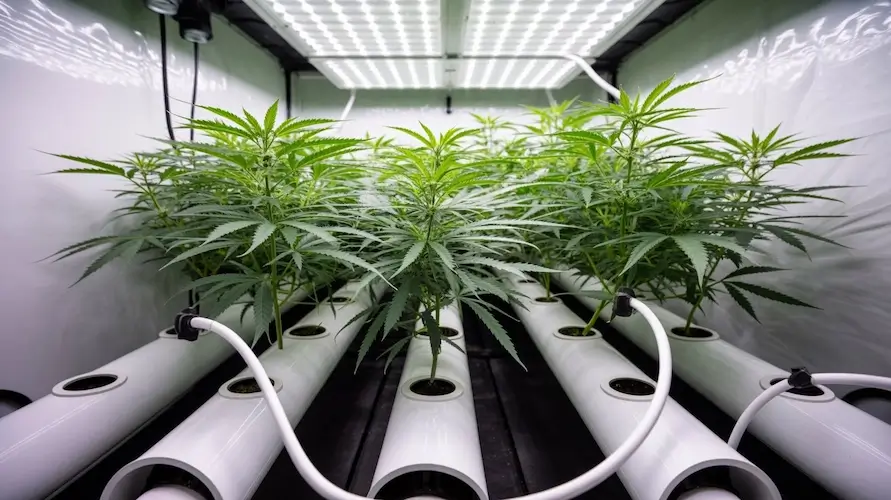
I’ve watched a lot of growers chase the “perfect” hydro system over the last sixteen years running Seeds Here Now. Nutrient film technique gets brought up constantly, usually by someone who saw a slick commercial lettuce operation and figured it’d translate straight to weed. It can. But NFT is not the plug-and-play system people think it is, and it’s not the one I hand a first-timer. Let me walk you through how it actually works, where it shines, and the failure mode that will cook your whole crop in an afternoon.
What Nutrient Film Technique Actually Is
NFT is a recirculating hydroponic method. You’ve got a reservoir of nutrient solution, a submersible pump, and a series of slightly sloped channels (usually PVC gullies or rectangular grow tubes). The pump pushes solution to the high end of each channel, and gravity carries a thin film of water down across the bare root mass and back into the reservoir. Then it does it again. And again. Constantly.
The key word is film. We’re talking a shallow stream, roughly 1 to 3mm deep. The bottom of the root mat sits in that moving water and drinks, while the bulk of the roots hang in humid air above the film. That’s the whole trick: you get near-constant access to water and dissolved nutrients on one side, and a ton of atmospheric oxygen on the other. Roots love oxygen. In a well-run NFT channel they grow thick, white, and fast.
Because the solution recirculates, NFT is efficient. You’re not dumping runoff. Water use is a fraction of soil, and you can dial your feed with real precision because every plant on a channel is drinking from the same tuned reservoir. No media to speak of either, beyond a small net pot with a plug of rockwool or clay pebbles to hold the stem upright while the root system establishes.
The Numbers I’d Run
NFT rewards tight control, so here are the targets I keep growers on:
- pH: 5.6 to 6.0. Hydro roots want it lower than soil. I hold around 5.8.
- EC: roughly 1.2 to 1.6 mS/cm in veg, climbing to 1.8 to 2.2 in flower depending on how hard your genetics feed. Watch the plant, not just the meter.
- Water temperature: 65 to 68°F. This is the one people ignore and regret. Warm water holds less dissolved oxygen and turns into a Pythium breeding tank.
- Flow rate: about 1 to 2 liters per minute per channel. Enough to keep a continuous film without flooding the gully.
- Reservoir: keep it cool, keep it dark, keep it aerated with an air stone as backup oxygenation.
If you can’t hold water temp in a hot room, buy a chiller before you buy anything else. I’m not exaggerating. A cheap chiller has saved more NFT crops than any nutrient line on the market.
Why NFT Works Well for Cannabis
When it’s dialed, NFT produces fast, aggressive vegetative growth. That high oxygen availability at the root zone drives uptake, and plants respond by packing on structure quickly. For a grower running a sea-of-green or a scrog, that speed is money.
It also plays beautifully with a trained canopy. NFT channels are linear and modular, so it’s natural to run plants in a row under a screen. Here’s where your genetics start earning their keep. A flat, even scrog canopy only works when every plant grows at a similar rate and stretches to a similar height. Run a pack of unstable seed and you get a canopy full of runts and stretchers, holes in the screen, uneven light penetration. Run stable, uniform genetics and the whole channel fills in like it was cloned. That uniformity is the single biggest reason I push serious hydro growers toward proven, stabilized lines instead of whatever bag seed they found.
The other efficiency win is scale. NFT is genuinely modular. Add another channel, add another set of net pots, tie it into the same reservoir. Commercial operations like it for exactly this reason, and it’s why you see it in professional rooms more than in closets.
The Cons Nobody Puts on the Sales Page
Here’s the honest side, because I’m not here to sell you a dream.
Pump failure will kill your plants fast. This is the defining weakness of NFT and you need to internalize it. In deep water culture, if your pump dies the roots are still sitting in a reservoir of water; you have hours, maybe a day, to notice. In NFT, the entire water supply is that thin moving film. Kill the pump and within a couple of hours that film evaporates off the roots and they start drying out and dying. A power outage, a clogged line, a failed pump on a hot day, and you can lose a crop before you get home from work. If you run NFT, you run a backup pump, a battery backup or generator, and ideally an alarm.
Cannabis taproots clog channels. Weed grows a far heavier, thicker root mass than lettuce or herbs. Those roots can bunch up in the gully, dam the flow, and pool water behind the blockage while starving plants downstream. You have to design channels wide enough and check them.
It’s temperature-sensitive. Thin, moving, recirculating water in a warm grow room heats up and drops oxygen right when the roots need it most. Root rot in NFT moves fast.
It’s not beginner-friendly. There’s real reason NFT is less common than DWC among home growers. DWC is more forgiving. A bucket of well-oxygenated water buffers your mistakes; a 2mm film punishes them immediately. Between the pump-failure risk, the clogging, and the tight temperature window, NFT asks for a grower who already understands hydro fundamentals.
Building and Maintaining a Channel
If you’re set on NFT, build it to survive its own worst day. A few things I’d insist on:
Redundancy first. Two pumps, not one, with the backup ready to swap in. A battery backup or generator sized to run the pump through a typical outage. If you can wire in a flow sensor or a simple float alarm that screams when water stops moving, do it. The whole risk profile of NFT changes the moment you can catch a pump failure in minutes instead of hours.
Right-size the slope and channel. You want a gentle grade, around a 1:30 to 1:40 drop, enough for the film to move without pooling. Too flat and water stagnates and starves oxygen; too steep and it races past the roots without feeding them. Use channels wide enough to handle a cannabis root mass without damming.
Stay on top of cleaning. Recirculating systems accumulate salt buildup, biofilm, and root debris. Flush and scrub channels between runs, keep the reservoir covered and cool, and change your solution on a regular schedule rather than endlessly topping off, which lets EC and pH drift.
Companion crops are real. One nice feature of NFT is that you can run fast leafy companions on spare channel space while your cannabis establishes. It’s not a game-changer, but it uses the system efficiently and gives beginners low-stakes practice reading the same water chemistry.
Why DWC Usually Wins for the Home Grower
I’ll say it plainly: most people asking me about NFT should probably start in DWC or a recirculating bucket system. Deep water culture gives you the same oxygen-rich, fast-growth benefits with a fraction of the catastrophic-failure risk. The larger water volume is a buffer against temperature swings, pH drift, and pump death. You learn the fundamentals of feeding and reading plants without a two-hour window to disaster hanging over you.
NFT earns its place when you’re scaling, when you want a trained linear canopy, and when you’ve got the discipline and the backup systems to respect its one big weakness. It’s a professional’s tool. There’s nothing wrong with that, as long as you know what you’re signing up for.
Where Genetics Comes In
An NFT setup is an investment: pumps, channels, chiller, monitoring, redundancy. The last thing you want is to fill an expensive, precision-tuned system with plants that turn out to be male, or a canopy of mismatched phenotypes. That’s why feminized seed is the default for most hydro growers running sinsemilla. You eliminate the coin-flip of sexing and the risk of a missed male pollinating a whole recirculating room. And stable, well-bred genetics give you the uniform canopy that makes scrog and sea-of-green in NFT actually work. Cheap, unstable seed in a high-end hydro build is a false economy. Put good genetics in a good system.
FAQ
Is NFT better than DWC for cannabis?
Not “better,” different. NFT is more water-efficient and scales cleanly for trained linear canopies, but it’s far less forgiving. DWC buffers your mistakes with a big volume of water. For most home growers, DWC is the smarter start; NFT rewards experienced growers with backup systems in place.
What happens if the pump fails in an NFT system?
Your plants start dying within hours. The thin film is the only water supply, so when it stops moving it evaporates off the roots fast. Always run a backup pump and a battery or generator, and add a flow alarm if you can.
What pH and EC should I run in an NFT cannabis grow?
Hold pH around 5.6 to 6.0 (I target 5.8). Run EC around 1.2 to 1.6 in veg and 1.8 to 2.2 in flower, adjusting to how hard your particular strain feeds. Keep reservoir water at 65 to 68°F.
Do I need feminized seeds for a hydroponic NFT grow?
You want them. A recirculating system is expensive to build and easy to ruin with a rogue male. Feminized seed removes the sexing gamble, and stable genetics give you the uniform canopy that trained NFT setups depend on.
Grow It From Good Seed
A precision hydro system only pays off with genetics worth the effort. At Seeds Here Now I’ve spent sixteen years stocking stable, breeder-direct feminized lines that give you the uniform, predictable canopy an NFT or scrog setup is built for. Browse the feminized collection and start your next run with seed you can actually trust.
Suggested Articles

 09 Nov 2026
 7 min read
;)
;)
;)
 December 03, 2025


RESPONSES (0)
No responses yet. Be the first to respond!