


Managing High Humidity During the Cannabis Flowering Period

You can feel a wet room before you can measure it. The tent zipper comes down, warm air rolls out against your face like the door of a greenhouse in August, and the leaves inside look slightly limp even though the pots are heavy. Nothing is visibly wrong yet. That is the part that gets people. Managing high-humidity cannabis flowering rooms is less about reacting to damage and more about recognizing the conditions that make damage inevitable, because by the time you see gray fuzz inside a cola, the decision you needed to make was already three weeks behind you.
I have lost buds to wet air, and I have saved a crop by moving one fan and buying one dehumidifier. Both outcomes came down to the same handful of variables, and none of them were complicated. What follows is how I think about moisture in a flowering room: what it actually does to the plant, what controls it, what to do when the number on the meter is already too high, and how to keep the last two weeks of a run from undoing everything.
Late Flowering Is When the Room Turns Against You
Early in a grow, humidity is forgiving. Small plants in a large space release very little water into the air, seedlings and clones actually want moist conditions, and there is plenty of open room for air to move. Then the canopy fills in, the plants triple their leaf surface, and each one starts pumping several times the water it did in week two straight into the air around it. The room did not change. Its workload did.
At the same time, the plant’s architecture turns against you. Buds swell, they crowd each other, and dense flowers trap pockets of still, saturated air deep inside where no fan reaches. A humidity reading taken at the edge of the canopy can look reasonable while the interior of a fat cola sits far wetter. That gap between what you measure and what the flower experiences is the single most underrated risk in indoor growing.
Most growers aim for something in the range of 40% to 50% relative humidity through flowering, and drop toward 40% or below in the final weeks as buds thicken. Those targets are not magic numbers so much as a margin of safety. Botrytis, the fungus behind bud rot, and powdery mildew both need moisture to establish, and sustained readings above roughly 60% in a still room give them everything they are looking for.
The Three Levers That Actually Move Humidity
Relative humidity looks like one number, but it is the output of three inputs. Once you see it that way, troubleshooting stops being guesswork.
Moisture Going In
Almost all the water in your air came out of your plants. Transpiration is the dominant source, which is why humidity climbs as the canopy matures and spikes in the hours after lights on. Everything else is secondary but still real: standing water in trays, saturated coco or soil surfaces, wet floors, uncovered reservoirs, and hydroponic systems with open tops. Outdoor and greenhouse growers add rain, dew, and damp ground to that list.
Moisture Going Out
Air leaves your space through exhaust ventilation or gets stripped of water by a dehumidifier. In a vented tent, your ability to lower humidity is capped by the outside air you are pulling in. If the air in your basement sits at 70% relative humidity, no amount of exhaust will bring it below that. This is the moment when growers who have been fighting a humidity problem for weeks finally realize they need to dry the room the tent lives in, not just the tent.
Temperature, and Why Dew Point Matters
Warm air holds far more water vapor than cool air. That means the same absolute amount of moisture reads as a modest number at 80°F and an alarming one at 65°F. This is why lights-off is dangerous: the room cools, the air’s capacity shrinks, relative humidity climbs, and if surfaces cool below the dew point, water condenses directly onto leaves and buds. Liquid water sitting on a flower overnight is exactly the invitation Botrytis wants.
The practical takeaway is to watch your day-to-night temperature swing as closely as you watch humidity. A drop of more than 10 to 15°F when the lights go out will push relative humidity up sharply, even if not one drop of extra moisture enters the room.
What Wet Air Costs You Before Anything Rots
Bud rot gets all the attention because it is dramatic and total. But a room running consistently humid is quietly taxing the plant long before mold shows up, and these costs are the ones growers misattribute to feeding or genetics.
Transpiration is how a cannabis plant moves water and dissolved nutrients from the root to the leaf. When the surrounding air is already close to saturated, there is little gradient for water vapor to move into, so transpiration slows. Slower transpiration means slower delivery of the nutrients that travel with that water, and calcium is the classic casualty because it moves almost entirely by that route. You end up chasing a calcium deficiency in the leaves while your fertilizer solution is perfectly adequate. The problem is not the feed. It is that the plant has stopped drinking.
You will also see soil and coco stay wet for days, which sets up root problems and invites fungus gnats. Stems can grow soft and stretchy. Stomata stay open longer than they should. And late in flowering, buds that never fully dry between waterings tend to finish airy and less resinous than the same genetics grown in balanced conditions.
Here are the symptoms most often blamed on something else:
- Leaf tips and margins showing calcium-style damage despite correct feeding, because uptake stalled rather than supply failing
- Pots that stay heavy for 4 to 5 days, leading to overwatering that was never a watering-schedule mistake
- Slight, persistent leaf droop with no wilting and no dry medium
- Fungus gnats appearing in week 5 or 6 out of nowhere
- Water spots or a filmy residue on lower leaves each morning, which is condensation, not a nutrient issue
Bud Rot and Powdery Mildew: Two Problems, Two Responses
Botrytis, the One You Cannot Negotiate With
Bud rot starts inside the flower, usually at the densest point where a stem runs through the middle of a cola. The first outside sign is often a single sugar leaf that has gone pale, dry, and lifeless while everything around it looks fine. Pull gently on that leaf. If it slides out with no resistance, open the bud. Rotted tissue inside is gray to brown, dry-crumbly rather than slimy, and it may show fine gray fuzz.
There is no rescuing an infected site. Cut it out with a generous margin into healthy tissue, bag it immediately, and carry it out of the room rather than shaking spores across the canopy on the way. Then drop the humidity, increase the airflow, and inspect every dense bud in the room daily until harvest. Botrytis in one plant means the spores are already everywhere; whether they take hold depends entirely on the conditions you provide next.
Powdery Mildew, Which Behaves Differently
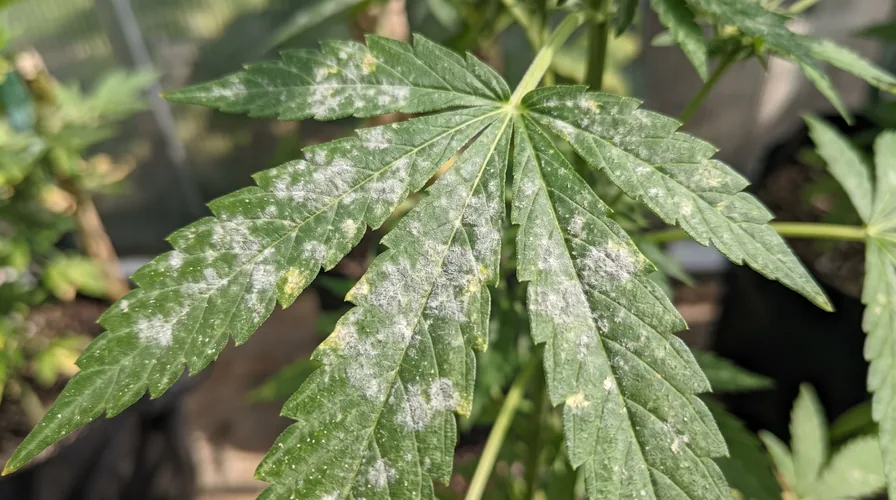
Powdery mildew shows up on leaf surfaces as flat white patches that look like dusted flour and wipe away with a fingertip, then return. Unlike bud rot, it does not require standing water and can spread in moderate humidity if airflow is poor and the room is crowded. Because it lives on the surface, it responds better to environmental correction, thinning the canopy, and treatment early in the cycle. Late in flowering, your options narrow, which is another argument for getting the air right before you need to intervene at all.
Emergency Triage for a Room Already Too Wet
If your meter reads 65% or higher in week six of the flowering period, follow the steps below.
Move air first, because it is free. Circulation does not remove moisture from a room, but it breaks up the saturated micro-pockets sitting inside and beneath the canopy, and that is where rot begins. Add an oscillating fan aimed to keep leaves in gentle constant motion, and place at least one fan low so it moves air under the plants where it usually stagnates. If you can see a patch of canopy that never moves, that is your next infection site. Keep that fan oscillating and off the tops, though, because a constant blast can cause wind burn on cannabis leaves.
Remove standing water. Empty runoff trays, cover reservoirs, mop the floor, and let the medium dry further between waterings than you normally would. Watering earlier in the light cycle gives surfaces hours to dry before the temperature drops.
Thin the canopy, carefully. Removing large fan leaves that are shading dense bud sites and blocking airflow helps significantly. Do it gradually. Stripping a plant bare in late flowering trades one stress for another, and the plant needs those leaves to finish.
Get a dehumidifier sized to the job. This is the fix people delay because of cost, and it is the one that actually works. Undersized units run constantly and never reach setpoint, so buy for the pint capacity your space and canopy demand rather than the smallest unit that fits. Vent the warm exhaust thoughtfully, because a dehumidifier adds heat to the room.
Shrink the nighttime temperature drop. If your lights-off temperature falls 15 to 20°F, add gentle heat during the dark period. Keeping the swing modest prevents the humidity spike and the condensation that follows it.
Increase exhaust only if the outside air is drier. Check the humidity of the room or space your intake pulls from before assuming more ventilation helps. Sometimes it makes things worse.
Building a Room That Holds Its Numbers on Its Own
Triage is what you do because prevention did not happen. The permanent fix is a space that regulates itself.
Start with a measurement you can trust. One hygrometer on the wall tells you very little. Put a sensor at canopy height in the center of the plants, and if your space is larger than a single tent, add a second in the corner with the worst airflow. Log the numbers across a full 24 hours rather than glancing at a display when you happen to walk in, because the peak you care about usually happens in the dark, when you are asleep.
Then automate. A dehumidifier on a humidistat or an environmental controller holds a setpoint whether you are home or not, and it can shift that setpoint as you move from early flowering into ripening. Pair it with fans on the same controller, and the room starts responding to conditions instead of waiting for you.
Sealed rooms and vented tents solve this differently. A sealed space with dedicated dehumidification and air conditioning gives you full control and is indifferent to the weather outside, at the cost of equipment and power. A vented tent is cheaper and simpler but permanently tied to the climate of whatever room it sits in, which is manageable if that room is dry and a losing battle if it is not.
Spacing matters more than most people expect. Crowded plants create dead air that no fan can reach. Giving each plant room, keeping the canopy open through the middle, and training for even light penetration all reduce humidity risk before any equipment is involved. So does strain selection: airy, open-structured flowers dry out between waterings in a way that dense, golf-ball buds simply do not, and growers in humid climates often do better with sativa-leaning structure for exactly that reason.
Outdoor and Greenhouse Growers Are Playing a Different Game
Outdoors, you do not control the air, so you control exposure and timing. Plant where morning sun hits early and dries the dew, keep plants off damp ground and away from dense shrubs that hold moisture, and prune the interior so wind can pass through rather than around. A plant that dries out by 9 a.m. is in a fundamentally different risk category than one that stays damp until noon.
Watch the forecast like it is part of your feed schedule. Several consecutive days of rain and cool nights during peak ripening are the highest-risk window of the entire season. Temporary cover over the plants, even a simple frame with plastic, buys you real protection during those stretches. In some seasons, the right call is harvesting a few days early rather than gambling on finished buds against a five-day rain. A slightly less mature harvest beats a rotted one, and that is a judgment call you make with your own eyes on the forecast and the flowers.
Greenhouse growers have the best and worst of both. You get shelter and a longer season, but a closed greenhouse traps transpired moisture and swings hard in temperature between day and night. Passive vents, roll-up sides, exhaust fans, and horizontal airflow fans all earn their keep, and a dehumidifier is not overkill in a greenhouse running through a wet autumn.
The Humidity Job Continues After You Cut
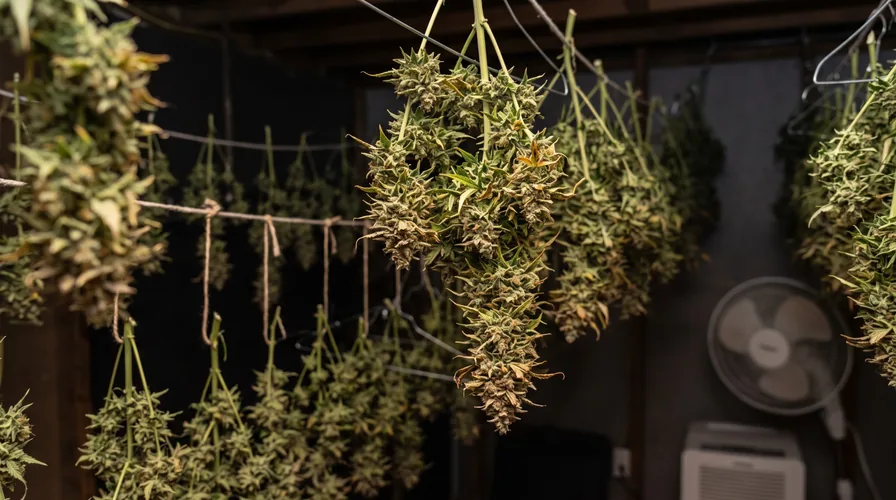
Everything you just did to keep moisture out of the flowering room reverses at harvest, and this is where a surprising number of otherwise clean crops are lost. Drying is a controlled humidity process, and rushing it undoes weeks of care.
A widely used starting point is a dark drying space held around 60°F with relative humidity near 60%, adjusted to your own conditions, with gentle air movement that never blows directly on the flowers. Dried too fast in dry air, buds go crisp outside while the stems stay wet inside, locking in that grassy, harsh quality. Dried too slowly in wet, still air, and you get mold in the drying room after surviving the whole grow. Aim for a hang of roughly 7 to 14 days, judged by whether a stem snaps rather than by the calendar.
Curing is the same discipline in a smaller container. Jars or bins held near 58% to 62% relative humidity, burped daily at first, then less often as the moisture evens out. If the buds feel damp after a day sealed up, take them out and dry them further before you seal them again. A rotting jar in week three of curing is the most avoidable loss in this entire process.
Frequently Asked Questions
What Humidity Level Should a Flowering Room Hold?
Most indoor growers target roughly 40% to 50% relative humidity through flowering, easing toward 40% or lower in the final 2 to 3 weeks as buds gain density. The exact number matters less than avoiding sustained readings above about 60%, keeping the day-to-night swing small, and making sure air is moving through the canopy rather than sitting in it.
Can I Fix High Humidity With Ventilation Alone?
Only if the air you are pulling in is drier than the air inside. Exhaust ventilation swaps the tent air for room air, so the humidity of the surrounding space sets your floor. When the room itself is humid, a dehumidifier in that room, or in the tent, is the only real solution.
Is a Humid Room Guaranteed to Cause Bud Rot?
No, but it stacks the odds heavily against you. Botrytis needs moisture, still air, and dense tissue to establish. Strong circulation and open bud structure can carry a grow through humid stretches, while a crowded, stagnant canopy can develop rot at readings that seemed acceptable on the meter.
Why Do My Plants Show Calcium Deficiency in a Humid Room?
Because calcium travels to the leaves in the water stream, and humid air slows transpiration, which slows that stream. The nutrient is present but not arriving. Adding more calcium rarely helps. Restoring the plant’s ability to transpire does.
Does Humidity Rise or Fall When the Lights Go Off?
It rises. Cooler air holds less water vapor, so the same moisture reads as a higher relative humidity, and the peak of your 24-hour cycle almost always occurs in the dark. Measure at night before you decide your room is under control.
Should I Defoliate to Deal With Humid Conditions?
Selective removal of large leaves that shade dense bud sites and block airflow genuinely helps. Aggressive stripping late in flowering does not, because the plant still needs leaf area to finish. Remove what is causing a dead-air pocket and leave the rest.
Do Certain Strains Handle Humidity Better?
Structure is the deciding factor. Open, airy flowers with space between the calyxes shed moisture far better than tight, dense buds that hold saturated air in the middle. Growers in humid regions often favor looser-structured, sativa-leaning genetics and varieties bred for outdoor performance in wet climates.
What Humidity Should I Dry and Cure At?
A common target is a dark room near 60°F and about 60% relative humidity for the hang, then jars or bins held around 58% to 62% for the cure. Judge the dry by the snap of the stem rather than a fixed number of days, and keep burping jars until the moisture inside stops climbing overnight.
Read the Air Before It Reads You
Wet air rarely announces itself. It shows up as a stalled feed chart, a leaf you blame on calcium, a pot that will not dry, and then, in the last two weeks, as a hollow gray cavity inside your best cola. Every one of those outcomes traces back to the same three levers: what is adding moisture, what is removing it, and how far the temperature falls at night. Get a sensor into the middle of your canopy, watch it through a full dark period, keep the air moving under the plants as well as over them, and buy the dehumidifier before you need it rather than after.
Genetics gives you a head start, too, and structure is the part that matters here. If you are planning a run in a humid basement, a wet climate, or a greenhouse heading into autumn, look for varieties with open flower structure and a track record outdoors in damp conditions. Browse the breeder-direct catalog and pick up high-quality seeds at Seeds Here Now to build your next grow around genetics that can handle the air you actually have.
Looking for more grow tips? Check out the Seeds Here Now blog. While you’re here, shop our wide selection of cannabis seeds and clones.
Suggested Articles
 10 Nov 2026
 12 min read

;)
;)
;)
 October 06, 2026


RESPONSES (0)
No responses yet. Be the first to respond!