


Ghost Train Haze Strain: A Seedsman’s Honest Breakdown of Denver’s Legendary Sativa


The Ghost Train Haze strain is Rare Dankness’s sativa-leaning hybrid of Ghost OG x Neville’s Wreck, bred in Denver, Colorado. It is famous for a sharp lemon-lime, citrus and incense aroma led by terpinolene, and its GTH #1 phenotype built the strain’s reputation.
I’m James Bean, founder of Seeds Here Now since 2010. This review covers Ghost Train Haze’s lineage, its Denver history, the aroma and how to spot authentic packs.
Seeds Here Now sells authentic breeder packs to adults 21+.
Ghost Train Haze at a Glance
| Trait | Ghost Train Haze |
|---|---|
| Lineage | Ghost OG x Neville’s Wreck |
| Breeder | Rare Dankness (Denver, Colorado) |
| Type | Sativa-leaning hybrid |
| Aroma | Sharp citrus, sour lemon-lime, floral incense, pine |
| Lead terpene | Terpinolene |
| Famous pheno | GTH #1 |
Lab figures vary by sample, so treat THC numbers as reported ranges, not guarantees.
Ghost Train Haze Genetics and History
Ghost Train Haze is Ghost OG crossed with Neville’s Wreck. Ghost OG is one of the most sought-after OG Kush cuts; Neville’s Wreck brings Haze and Trainwreck heritage tied to Neville Schoenmakers.
It is a Rare Dankness creation from Denver’s early-legalization breeding scene, when breeders were turning elite clone-only cuts into seed lines. The standout phenotype, GTH #1, was named among the strongest strains by High Times and earned Cup placements that made Rare Dankness’s name.
Ghost Train Haze Aroma and Appearance
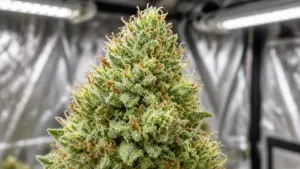
The Ghost Train Haze strain is sharp and bright: citrus, sour lemon-lime and a floral, incense-like top note on a terpinolene-forward profile, with pine and a faint OG gas underneath.
It should smell penetrating, not candy-sweet. If a pack sold as Ghost Train Haze produces a generic fruity aroma, be skeptical. Buds are long and heavily frosted.
Ghost Train Haze vs. Similar Strains
| Strain | Relation | Aroma |
|---|---|---|
| Ghost Train Haze | Ghost OG x Neville’s Wreck | Lemon-lime, incense |
| Ghost OG | Parent | Lemon, pine, fuel |
| Neville’s Wreck | Parent | Haze, citrus, spice |
Read our Ghost OG review.

Buying Ghost Train Haze
Ghost Train Haze seeds are widely imitated. Look for Rare Dankness packaging or a seller who documents the source. Browse our breeders index and regular seeds.
Rare Dankness and the Denver Breeding Scene
Rare Dankness is a Denver, Colorado breeder that rose to fame in the early years of Colorado’s legal market. At the time, many of the most sought-after cuts in the country were clone-only, meaning they existed only as cuttings passed between growers.
Breeders like Rare Dankness turned some of those elite cuts into seed lines, which made them available to buyers far beyond the circles that held the clones. The Ghost Train Haze strain is the best-known result of that work, and it made Rare Dankness one of the most recognized names in American breeding.
Why Colorado Mattered
Colorado’s early legal market gave breeders something they had rarely had before: the chance to work openly, publish their lineages and build a public reputation under their own names. Many of the breeders who became well known in the 2010s got their start in that environment.
Rare Dankness was one of them, and the Ghost Train Haze strain helped show that an American breeder could create a seed line with the kind of name recognition once reserved for Dutch seed companies.
The Ghost OG Parent
Ghost OG is one of the most respected OG Kush cuts. It is known for a lemon, pine and fuel aroma, the classic OG profile, and for heavy resin. Like many OG cuts, its exact history is based on the accounts of the growers who kept it.
In the Ghost Train Haze strain, Ghost OG is credited with the faint gas under the citrus, the frost and some of the structure. Our Ghost OG strain review covers the parent in more detail.

The Neville’s Wreck Parent
Neville’s Wreck is usually listed as Neville’s Haze crossed with Trainwreck. It ties the Ghost Train Haze strain to two important pieces of sativa history.
- Neville’s Haze: named for Neville Schoenmakers, whose Dutch seed company was one of the first to sell cannabis seeds by catalog in the 1980s and who did much to preserve and spread the Haze family.
- Trainwreck: a Northern California sativa-leaning classic, usually described as a mix of Mexican and Thai sativas with some Afghani, known for a sharp lemon and pine aroma.
In Ghost Train Haze, Neville’s Wreck is credited with the incense, spice and sour citrus. Read our Trainwreck strain review for that side of the family.
A Short History of the Haze Family
Haze is one of the oldest names in modern cannabis. As the story is usually told, it was developed in California in the late 1960s and 1970s by blending sativa landraces from places such as Mexico, Colombia, Thailand and South India. It was famous for a spicy, incense-like and citrus aroma.
Haze seeds reached the Netherlands in the 1980s, where Neville Schoenmakers and others worked with the line. Haze went on to become a parent of many celebrated sativa-leaning strains. When you smell incense in the Ghost Train Haze strain, you are smelling that heritage.
Why Clone-Only Cuts Matter
A clone-only cut is a single plant kept alive by taking cuttings, often for years or decades, without ever being released as seed. Many of the most famous OG Kush cuts, including Ghost OG, spent long stretches as clone-only plants.
Turning a clone-only cut into a seed line means crossing it with another plant and selecting from the offspring. That is what Rare Dankness did with Ghost OG and Neville’s Wreck. For buyers, it is the reason Ghost Train Haze seeds exist at all: they put a once-restricted cut into a form that anyone 21+ can hold.
GTH #1 and the High Times Recognition
The phenotype that built the strain’s reputation is GTH #1, a selection from the Ghost Train Haze line. It was named among the strongest strains in the world by High Times and earned Cup placements, which brought Rare Dankness national attention.
That recognition also brought imitation. As with any famous name, many packs and products use the Ghost Train Haze name without tracing back to Rare Dankness, so provenance matters.

Where the Name Comes From
The name joins the two parents. Ghost comes from Ghost OG, Train from Trainwreck by way of Neville’s Wreck, and Haze from Neville’s Haze. It is a lineage name, which makes it easy to see at a glance where the line came from.
That kind of naming is common among breeders who work from famous cuts, and it is one reason the Ghost Train Haze strain is easy to place in a family tree.
Ghost Train Haze Appearance
Photos of the Ghost Train Haze strain usually show long, tapered buds, a shape associated with its sativa-leaning Haze and Trainwreck heritage, under a heavy coat of frost. Colors are usually bright lime green with orange pistils.
The frost is usually credited to Ghost OG, which is known for heavy resin. Read more about cannabis trichomes.
Ghost Train Haze Terpenes
The Ghost Train Haze strain is known for a terpinolene-forward profile, which is less common in modern cannabis than myrcene or caryophyllene. Terpinolene is associated with fresh, citrusy, piney and slightly floral aromas.
That is where the sharp lemon-lime and incense character comes from. Supporting notes of pine and a faint OG gas round it out. Terpene levels vary by sample, and we describe them for aroma only, with no claims about effects. See what terpenes are.
How to Spot Authentic Ghost Train Haze Seeds
- Look for Rare Dankness as the named breeder, or a seller who documents where the line came from.
- Check for the Ghost OG x Neville’s Wreck lineage on the label or listing.
- Buy sealed, original breeder packaging.
- Be skeptical of listings that describe a generic sweet or candy aroma; Ghost Train Haze should be sharp and citrusy.
Keep the pack and receipt together, since provenance is part of the value.
Ghost Train Haze in a Sativa History Collection
Ghost Train Haze seeds fit well in a collection built around sativa-leaning history. Pair them with Trainwreck, Jack Herer and a Haze line to show how Dutch and Northern California sativas shaped modern breeding, and with Northern Lights for the classic indica counterpoint that Neville also worked with.
Keep each pack sealed, cool, dark and dry, out of reach of children and pets, with a note of the breeder and where you bought it.
Seeds, the Law and Our Rules
Cannabis laws differ by state, and federal hemp and seed rules are changing under Section 781. Check the law where you live before you buy anything. Our cannabis seeds by state guide links every state and its official sources, and our explainer on what Section 781 is covers the federal side.
Every buyer must be 21 or older. We sell seeds only to adults 21+.
Growing It
It is not.
Flowering time. Expect 9 to 11 weeks indoors, and the best phenos lean to the longer end. This is a Haze-influenced sativa; if you’re the type who wants everything chopped at 8 weeks, GTH will frustrate you. Rush it and you throw away the potency and the terpene development that make this strain worth growing.
Stretch. Massive. Plan for it to double, sometimes triple, in height during the flip. If you’re in a short tent, you need to flip early and manage height aggressively. This is a plant that wants training — topping, LST, a good screen. Let it run wild and you’ll get a lanky, airy mess with a few good colas and a lot of larf.
Structure and foxtailing. GTH tends toward long, spear-shaped colas and can foxtail under heat or intense light. That’s characteristic, not necessarily a defect, but it changes how you read ripeness — watch the trichomes, not the pistils.
Hermie tendency. I’m going to be straight with you: Haze-heavy sativas like this can throw nanners under stress — heat spikes, light leaks, overrun flowering times, sloppy environment. GTH is not the worst offender, but it’s not bombproof either. Keep your environment tight and your light schedule clean and you’ll be fine. Abuse it and it can protect itself by throwing pollen.
It’s not a commercial-weight, do-nothing strain — the reward is quality and potency, not sheer bulk.
Bottom line: dial-in environment, patience for a long flower, and vertical space. Give it those three things and GTH rewards you like few sativas can. Miss on any of them and you’ll understand why I flag it as an experienced-grower strain.
Frequently Asked Questions
What is the Ghost Train Haze strain?
A sativa-leaning hybrid from Ghost OG x Neville’s Wreck, bred by Rare Dankness.
Who bred Ghost Train Haze?
Rare Dankness, based in Denver, Colorado.
What is Ghost Train Haze’s lineage?
Ghost OG x Neville’s Wreck.
What does Ghost Train Haze smell like?
Sharp citrus and sour lemon-lime with a floral, incense-like note.
What is GTH #1?
The standout phenotype selection that built the strain’s reputation.
What is Neville’s Wreck?
A cross of Neville’s Haze and Trainwreck, and one of the two parents of Ghost Train Haze.
Who was Neville Schoenmakers?
A pioneer of the Dutch seed industry in the 1980s, closely associated with the Haze family.
What is terpinolene?
A terpene associated with fresh citrus, pine and floral aromas, and the lead terpene in Ghost Train Haze.
Can I buy Ghost Train Haze seeds if I am under 21?
No. We sell seeds only to adults 21 and over.
What is a clone-only cut?
A single plant kept alive by cuttings rather than released as seed. Ghost OG spent years as a clone-only cut.
Where does the Haze family come from?
As it is usually told, Haze was developed in California from several sativa landraces before reaching the Netherlands in the 1980s.
Is Ghost Train Haze a sativa?
It is usually listed as a sativa-leaning hybrid.
What does GTH #1 mean?
It is the name of the standout phenotype selected from the Ghost Train Haze line, the plant that built the strain’s reputation.
Is Ghost Train Haze related to Trainwreck?
Yes. Trainwreck is one of the parents of Neville’s Wreck, which is one of Ghost Train Haze’s two parents.
Bottom Line
Ghost Train Haze earns its place with its lineage and a distinctive aroma.
Sources
Key Facts About Ghost Train Haze
| Lineage | Ghost OG x Neville’s Wreck |
|---|---|
| Breeder | Rare Dankness (Denver, Colorado) |
| Type | Sativa-leaning hybrid |
| Aroma | Sharp citrus, sour lemon-lime, floral incense, pine |
| Lead terpene | Terpinolene |
| Famous phenotype | GTH #1 |
| Where to buy | Seeds Here Now, authentic breeder packs for adults 21+ |
Last updated October 7, 2026 by James Bean, founder of Seeds Here Now. Nothing here is legal advice. See our disclaimer, terms of use and shipping policy.
Suggested Articles
 10 Nov 2026
 12 min read


;)
;)
;)
 March 21, 2025


RESPONSES (0)
No responses yet. Be the first to respond!