


Cannabis Light Stress: Symptoms and Solutions
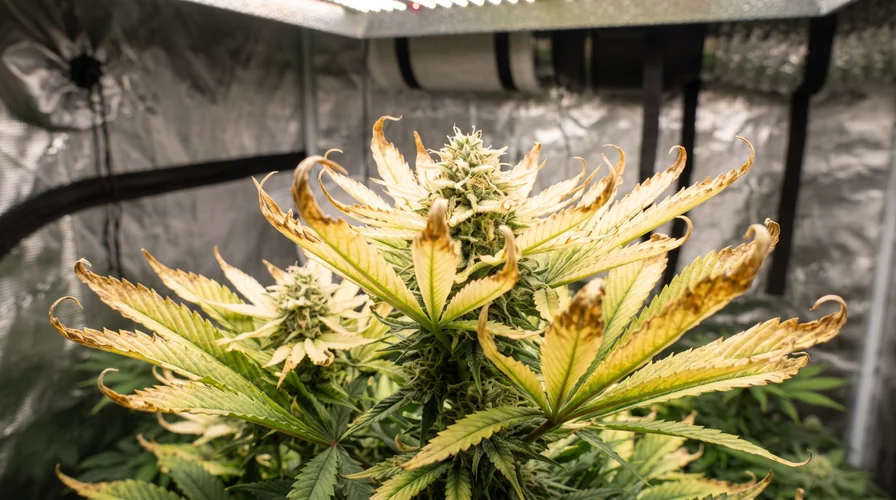
Here is the part that keeps growers spinning in circles: a plant getting far too much light and a plant getting nowhere near enough can both hand you pale leaves, curled edges, and disappointing buds. The symptoms overlap enough that plenty of people respond to a starved canopy by raising the fixture even higher, then watch the plant get worse and conclude that light was never the issue. Understanding cannabis light stress symptoms means learning to separate two opposite failures that share a vocabulary, and then adding a third possibility that has nothing to do with brightness at all.
I run a light meter in my rooms now for exactly this reason. Not because numbers make me a better grower, but because guessing at light was costing me weeks per cycle. What follows is how I sort the three kinds of light stress apart, what each one actually does inside the plant, and how to correct them without swinging the pendulum straight into the opposite problem.
Three Dials, Not One
Light is not a single input. Your plants respond independently to three properties of it, and each one has its own failure mode.
The first is intensity, meaning how much photosynthetic light lands on a leaf at any given moment. Too much of it overwhelms the machinery in the leaf and damages tissue. Too little starves the plant of the energy it needs to build anything substantial.
The second is duration, meaning how many hours of light the plant receives and, just as importantly, how many uninterrupted hours of darkness. Cannabis reads day length to decide whether to grow or to flower, and it takes that reading seriously.
The third is consistency. Plants adapt to conditions gradually. A canopy that has spent 3 weeks under moderate light and then gets slammed with double the intensity overnight suffers even if the new level would have been perfectly fine had you arrived there slowly.
Almost every light problem I have diagnosed traces to one of those three dials being wrong, and the fix for each is different. Turning the wrong dial is how growers turn a minor setback into a lost month.
Overexposure: When the Leaf Cannot Use What It Is Given
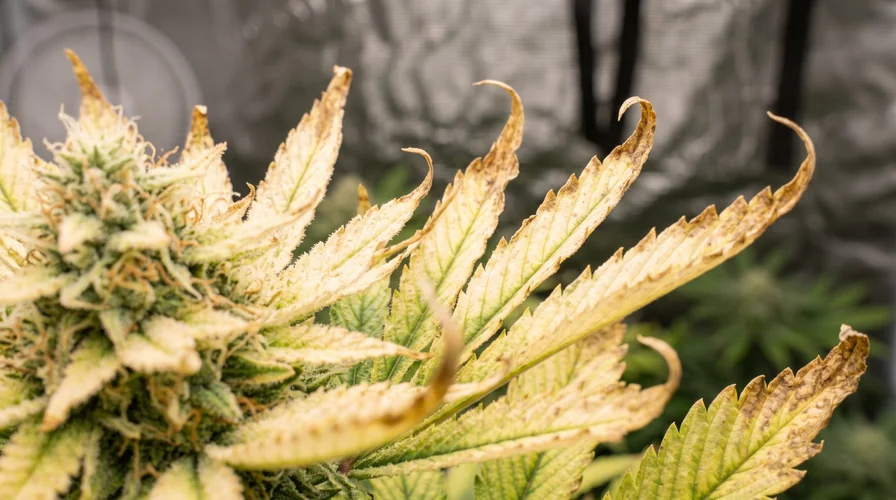
A leaf converts light into sugar at a finite rate. Push past that rate, and the surplus energy does not politely wait in line; it starts damaging pigments and cell structures. The plant defends itself by shedding chlorophyll in the most exposed tissue, which is why the classic signature of too much light is fading from the top down.
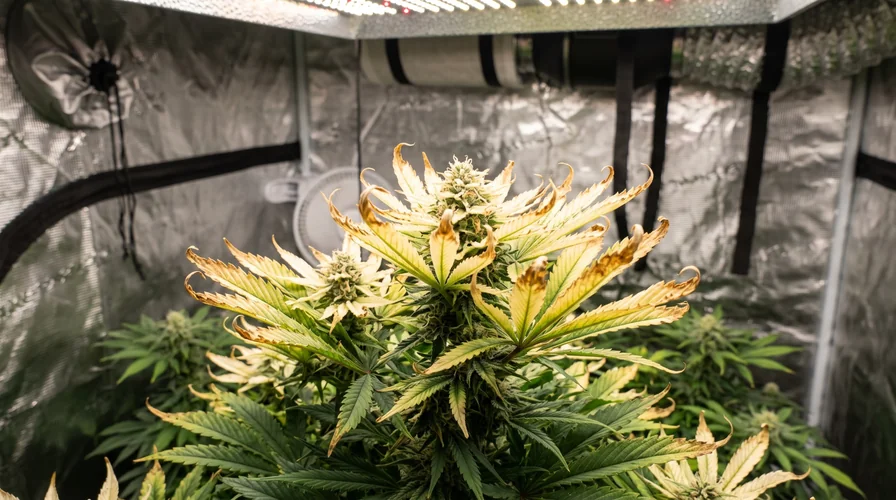
The tops go pale, then yellow, then, in serious cases, near white, while the lower and shaded leaves stay a normal healthy green. The gradient follows distance from the lamp rather than leaf age, which is the detail that separates it from a nutrient problem. Deficiencies follow the plumbing of the plant. Overexposure follows the geometry of your fixture.
Alongside the fading, you will often see leaf edges cupping upward and inward as the plant reduces the surface it presents to the lamp, tips going crisp and papery, and a canopy that holds its leaves stiffly upright in what growers call the praying position. Praying by itself is not a problem; it is an indicator, and its meaning depends on what else is happening. A vigorous plant reaching toward the light is fine. A plant praying with bleached tips is asking you to back off.
Intensity That Is Only a Problem in Context
This is the wrinkle that sends people chasing ghosts. The same intensity a plant handled comfortably last week can hurt it this week if something else changed, because a leaf’s capacity to use light depends on everything else being available.
If the room runs hot, the leaf is already spending energy on cooling and has less headroom for photons. If the air is very dry, stomata close to conserve water and the carbon dioxide supply to the leaf drops with them, so the light arriving has nothing to work with. If the root zone is cold, compacted, or rootbound, water and nutrient delivery cannot keep pace with the demand that bright light creates. If the plant is recovering from transplant shock or a pest knockdown, its whole budget is elsewhere.
In every one of those cases, the fixture did not change; the plant’s capacity did. That is why I check temperature, humidity, and the root zone before I touch the light. Sometimes the correct answer to apparent light stress is to fix the airflow or water the plant properly and leave the lamp exactly where it is.
Underexposure: The Stress That Never Gets Diagnosed
Too little light rarely gets blamed, because it does not produce dramatic damage. It produces mediocrity, and mediocrity is easy to explain away as bad genetics or a bad run.
The clearest tell is architecture. A plant reaching for insufficient light stretches, putting energy into vertical distance rather than mass. Internodes lengthen, stems stay thin and flexible, and the plant grows tall without filling in. Leaves come in larger but thinner, and they angle themselves flat and wide, sometimes drooping slightly, as if trying to catch every photon available. Lower growth on a light-starved plant often yellows and dies off entirely because the plant will not fund leaves that cost more than they produce.
In flowering, the cost shows up in the harvest. Bud sites form but stay loose and airy, colas develop without density, ripening drags on past the expected window, and trichome production comes in noticeably thinner. Growers frequently blame the strain for this. Often the strain never had a chance.
Light starvation is also position-dependent inside a single plant. The tops may look excellent while everything below the upper canopy produces almost nothing, which is a sign the light is not penetrating rather than that the fixture is weak. That distinction matters, because the fix for poor penetration is training, defoliation, and plant spacing, not a bigger lamp.
Timing Stress: When the Clock Is the Culprit
The third category has nothing to do with brightness. Photoperiod cannabis plants use the length of the uninterrupted dark period to determine whether they are in vegetative growth or in bloom, and disrupting that signal produces stress that no amount of intensity tuning will fix.
An Interrupted Dark Period
A dark period broken by light in the middle can partially reset the plant’s flowering signal. The plant responds with confused growth: new white pistils emerging from finished buds, leaves growing directly out of colas, foxtailing towers stacking on top of otherwise mature flowers, and in genetically susceptible plants, male flowers appearing on a female plant. The last one is the expensive outcome, because it can seed the harvest.
The frustrating part is that the plant does not distinguish between a genuine light leak and you opening the tent to check on things with the room lights on. Consistency is the whole point of the dark period.
Schedule Changes and Revegetation
Moving a plant backward, from a 12-hour day to a longer one, tells it that the season reversed. It will attempt to return to vegetative growth, a process called revegetation, and the transition is slow, ugly, and costly. Single-blade leaves emerge, buds go leafy, and the plant spends weeks reorganizing itself.
Nudging the schedule around in flower creates milder versions of the same confusion. Set the timer, verify it is holding, and leave it alone.
Where Autoflowers Differ
Autoflowering plants bloom on age rather than photoperiod, so they will not reveg or herm from a dark-period interruption the way photoperiod plants can. They are not immune to light stress, though. They still bleach under excessive intensity, still stretch and underperform in dim conditions, and because their timeline is fixed, they have far less room to recover. A week lost to overexposure on an autoflower is a week you do not get back.
A 10-Minute Diagnostic Path
When something looks wrong, I run through the same short sequence before changing anything. It resolves most cases without guesswork.
Start with distribution. Note exactly which leaves are affected and where they sit. Damage concentrated at the tops closest to the lamp points to intensity. Symptoms spread by leaf age regardless of height point to nutrition. Poor growth confined to lower and interior branches points to penetration. One-sided damage that matches your fan points to airflow, not light.
Next, read the texture. Overexposure bleaches and dries, leaving pale, crisp, brittle tissue. Nutrient issues discolor tissue that still feels normal and pliable. Nitrogen excess produces dark, glossy, thick leaves that claw while looking well fed. Those three feel different between your fingers.
Then measure rather than estimate. A PAR meter or a decent smartphone app reading at canopy height turns an argument into a number, and a room thermometer and hygrometer at canopy height tell you whether the plant even has the capacity to use the light it is getting. Widely used targets run roughly 200 to 400 µmol for seedlings and fresh clones, roughly 400 to 600 µmol through vegetative growth, and roughly 600 to 900 µmol in flower, with the upper end of the flowering range assuming your temperature, humidity, and carbon dioxide are all dialed in.
Finally, check what changed. Light stress almost always follows an event: a new fixture, a dimmer adjustment, a defoliation that exposed shaded leaves, a transplant, a heat wave, or plants moved from a nursery area into a flowering room. Identifying the event usually identifies the cause.
Correcting Each Kind Without Overshooting
Backing Off Excessive Intensity
Reduce the intensity by dimming the fixture or raising it, and make the change modest. A cut of roughly 10% to 20%, or a lift of a few inches, is usually enough to stop the progression. Dropping the light to half power in a panic swaps overexposure for underexposure and stalls the plant a second time.
Leave the damaged leaves attached unless they are fully dead. Bleached tissue will not regain its color, and stripping ugly-but-living foliage adds stress to a plant that is already managing some. Judge your correction by the new growth: within roughly 1 to 2 weeks, the fresh sets at the top should come in evenly green and correctly shaped.
Resist the urge to feed a light-stressed plant more. Pale leaves invite a nitrogen response, and adding salts to a plant that cannot process the light it already has is how a light problem becomes a light problem plus a lockout.
Adding Light Without Adding Trouble
If the plant is starved, raise the intensity in steps over several days rather than all at once, and watch the canopy after each step. Also confirm the shortfall is really about output. Dusty lenses, aging bulbs, a fixture hung too high for the footprint it covers, and plants sitting outside the strong center of the beam all reduce delivered light without any dial being wrong.
When the tops look great, and everything underneath produces nothing, the answer is distribution rather than power. Low-stress training to flatten the canopy, selective removal of leaves that shade bud sites, and giving each plant enough floor space all get more light into the parts of the plant that were doing nothing.
Stabilizing the Clock
Verify the timer physically rather than trusting it, seal the room against outside light, and cover or tape over the indicator LEDs on fans, controllers, and power strips. Sit inside the closed room for several minutes during lights-out and look for anything you can see once your eyes adjust. If you must enter during the dark period, use a dim green light and keep it brief.
If a plant has already thrown a few male flowers from a photoperiod disruption, remove them carefully, fix the cause, and monitor closely. If the plant keeps producing them, the safest move for the rest of your run is to pull it.
Preventing the Next Round
Most light stress I see now comes from transitions rather than from a badly chosen light level, so transitions get the attention.
Introduce plants to stronger light gradually. Clones and seedlings coming out of a humidity dome or a propagation area need a few days at reduced intensity before they meet a flowering-strength lamp. Plants moved outdoors need a similar hardening-off period, because direct sun is a considerable step up from most indoor rooms.
Ramp intensity as the plant gains capacity instead of setting it once and forgetting it. A rooted clone and a plant in week 4 of flower want very different things, and a fixture at a fixed output is wrong for at least one of them.
Keep the rest of the environment in range so the light has something to work with. Comfortable canopy temperatures, humidity appropriate to the stage, steady airflow, and a healthy root zone are what make high intensity productive rather than punishing. Growers who chase big numbers on a light meter while ignoring everything else are the ones who get bleached tops.
Finally, take notes. A short log of fixture height, dimmer setting, schedule, and what the canopy looked like turns each cycle into information you can use, and it tells you exactly what changed when something goes sideways.
Frequently Asked Questions
Can Too Little Light Really Look Like Too Much?
They share several symptoms, including pale leaves, poor bud development, and unhappy lower growth. The distinguishing features are structure and location. Starved plants stretch, thin out, and stay flexible, with problems concentrated low and inside the canopy. Overexposed plants stay compact while fading at the very top, closest to the lamp.
What Is the Difference Between Light Stress and Heat Stress?
Heat stress typically folds leaf edges upward into a taco shape and clusters directly under the hottest part of the fixture, and it improves when you cool the room without moving the light. Excessive light intensity bleaches and fades tissue and follows distance from the lamp. The two frequently occur together, which is why it is worth measuring both temperature and intensity at canopy height before deciding.
Will Bleached Leaves Turn Green Again?
No. Tissue that has lost its chlorophyll to overexposure does not recover its color. Your evidence that the correction worked is new growth emerging evenly green, not old leaves improving.
Do LED Fixtures Cause Light Stress?
Yes, and they catch people off guard because the fixture does not radiate much heat. A grower who learned lamp distance by feeling for warmth will hang an LED far too close and deliver intensity well past what the plant can use. Judge LED height by a meter reading or by the canopy’s response, never by the back of your hand.
How Long Does It Take a Plant To Recover?
Once the cause is corrected, healthy new growth generally appears within roughly 1 to 2 weeks, though a plant that was stressed hard in flower may not fully make up the lost bud development before harvest. Autoflowers recover more slowly in practical terms because their schedule does not wait for them.
Is Leaf Praying a Sign of Stress?
On its own, no. Leaves angling up toward the light usually indicate a plant with plenty of energy and a comfortable environment. It becomes a warning only when it appears together with bleaching, crisp tips, or curling edges at the top of the canopy.
Should I Turn the Lights Off To Let a Stressed Plant Rest?
Not in flower, where an off-schedule dark period risks the photoperiod confusion described above. Reduce intensity instead, keep the schedule exactly as it is, and let the plant recover under a lighter load rather than in the dark.
Do Some Varieties Tolerate Intense Light Better?
Tolerance does vary. Plants with landrace equatorial heritage often handle high intensity better than varieties bred for cooler, dimmer conditions, and structure plays a role too, since a plant that naturally grows compact keeps more of its foliage near the lamp. Breeder notes and grow reports are worth reading before you build a run around a hard-driven fixture.
Read the Canopy, Then Turn the Right Dial
Light stress stops being mysterious the moment you stop treating light as one setting. Ask whether the problem is intensity, duration, or a change the plant had no chance to adapt to. Look at where the damage sits and how the tissue feels. Measure at canopy height instead of estimating from the ceiling. Then make a small, deliberate adjustment and let the new growth tell you whether you were right. That loop, run patiently, will teach you more about your room than any chart. And because how a plant handles a hard-driven lamp starts with what it was bred to do, genetics are worth choosing with your specific setup in mind. Browse the breeder-direct catalog at Seeds Here Now and pick varieties suited to the light you actually run.
Check out the Seeds Here Now blog for more expert grow tips. While you’re here, shop our wide selection of premium cannabis seeds and clones.
Suggested Articles

 12 Nov 2026
 12 min read

;)
;)
;)
 October 13, 2026


RESPONSES (0)
No responses yet. Be the first to respond!