


Is Your Tap Water Bad for Cannabis?
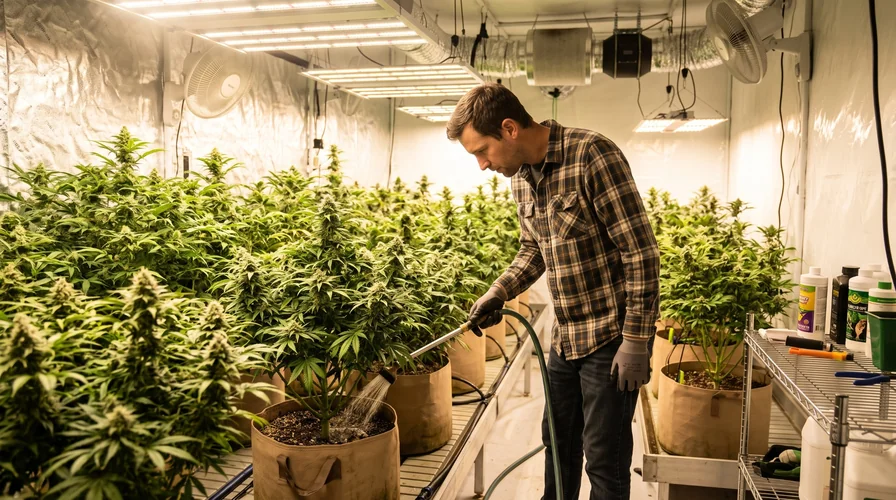
Tap water is not the villain the grow forums make it out to be. Somewhere along the way, “just use RO” hardened into gospel, and now people run reverse osmosis in cities with genuinely excellent municipal water, strip out calcium and magnesium they were getting for free, then buy those same minerals back in a bottle labeled Cal-Mag. Meanwhile, a grower two states over is fighting a stubborn pH climb in coco and blaming the nutrient line, when the actual culprit is 220 ppm of bicarbonate coming out of the kitchen faucet. Both of those growers are asking the same question, and it is the wrong one. “Is tap water bad?” has no answer. “What is in my tap water, and does it matter for what I am growing in?” has a very specific one.
I have used tap water straight from the hose for entire successful runs, and I have also had a water source that made coco unmanageable until I dealt with it. Same grower, same nutrients, completely different water. The bad tap water cannabis growers actually need to worry about is a short list of specific contents at specific concentrations, and every item on that list is something you can look up in an afternoon. This is how to find out where your water sits, what each number does to a plant, and which fixes are worth paying for.
Your Water Report Is a Free Diagnostic
Anyone on a municipal system in the U.S. can read exactly what is in their water without buying anything. Water utilities are required to publish an annual water quality report, often called a Consumer Confidence Report, and it is usually posted on the utility’s website or mailed once a year. It lists the disinfectant in use, hardness, alkalinity, sodium, and a long tail of regulated contaminants, generally with an annual average and a range.
Two caveats keep that report honest. First, it describes water leaving the treatment plant and traveling through the mains, not water arriving at your tap after passing through your building’s plumbing. Second, many utilities blend sources seasonally, so a single annual average can hide a real swing between spring and late summer.
That is where two cheap tools earn their place. A TDS or EC meter tells you the total dissolved mineral load in the glass in front of you, which is the number you need before you mix a single drop of nutrients. A drop-test hardness kit, the kind sold for aquariums, gives you carbonate hardness in a few minutes. Between the published report and those two readings, you know more about your water than most people who have been growing for a decade.
What Actually Matters, Line by Line
Chlorine Versus Chloramine
These get lumped together, and they behave nothing alike. Chlorine is volatile. Left in an open container for 12 to 24 hours, or run through an air stone for an hour or two, most of it leaves on its own. Chloramine is chlorine bonded to ammonia specifically so that it will not dissipate in the distribution system, which is exactly why letting it sit accomplishes almost nothing. Utilities increasingly use chloramine, and your water report will say which one you have.
The practical concern is different depending on how you grow. At normal municipal residential levels, neither disinfectant is going to burn a plant. What they do is suppress microbial life, which matters enormously if you are running a living soil, a compost tea program, or a mycorrhizal inoculant, and matters very little if you are feeding a synthetic salt line in coco or a recirculating hydro system where you are managing sterility anyway. A living-soil grower with chloraminated water should filter it. A hydro grower with the same water can usually ignore it.
Hardness, Which Is Often a Gift
Hardness is dissolved calcium and magnesium, reported in parts per million as calcium carbonate. The rough municipal categories run soft below 60 ppm, moderately hard from 61 to 120 ppm, hard from 121 to 180 ppm, and very hard above 180 ppm.
Here is the part that surprises people: calcium and magnesium are nutrients your plant needs in significant quantities. Moderately hard water is doing part of your feeding for you. Growers on soft or reverse-osmosis water are the ones who run into calcium and magnesium deficiencies, and the entire Cal-Mag supplement category exists largely to serve them. If your water sits in that moderate band, you may be able to run a lighter supplement schedule than the bottle recommends, or skip the supplement entirely with a nutrient line formulated for hard water.
Very hard water is a different story, and the trouble it causes is usually not the calcium itself. It is what travels with it.
Alkalinity, the Number Nobody Checks
This is the one I wish more growers understood, because it explains more mystery pH problems than anything else in the water. Alkalinity is not pH. pH tells you where the water sits right now. Alkalinity, made up mostly of bicarbonates and carbonates, tells you how hard the water will fight to stay there.
Water with high alkalinity is chemically stubborn. You add pH-down until the meter reads 6.0, walk away, and come back to find it drifted up. Worse, those carbonates do not vanish once the water is in the pot. They accumulate in the medium and push root-zone pH steadily upward over weeks, which locks out iron, manganese, and zinc, and produces interveinal yellowing on new growth that looks exactly like an iron deficiency. Growers respond by adding more iron. The iron was never missing. It was unavailable.
Below roughly 100 ppm of alkalinity, most growers never notice it. Above roughly 150 ppm, it becomes a real force acting on your medium, and it gets worse the less buffering capacity that medium has. Soil with a healthy organic fraction absorbs a lot of abuse here. Coco and inert hydro media absorb almost none, which is why the same tap water can be invisible in soil and unmanageable in coco.
Sodium and Chloride
Sodium is the item on the report I check first for a hard no. Plants have no meaningful use for it, roots take it up in competition with potassium and calcium, and it builds up in the medium with every irrigation because nothing consumes it. Coastal utilities, systems with saltwater intrusion, and areas that use road salt heavily can all run elevated. Sodium above roughly 50 ppm deserves attention, and much higher than that on a source you use every day will eventually show up as tip burn, stunted growth, and a medium you cannot flush back into range.
Fluoride and the Long Tail
Fluoridated systems in the U.S. typically target somewhere near 0.7 ppm. Certain ornamental houseplants are famously fluoride-sensitive at low concentrations, and that fact gets borrowed and applied to cannabis with more confidence than the evidence supports. At municipal levels, it is not a plausible explanation for a struggling plant, and the same is true of the trace regulated contaminants further down the report. If you have a fixable problem, it is almost certainly higher on this list.
Iron and sulfur are worth a glance because they announce themselves. Rust-colored staining, a rotten-egg smell, or visible sediment usually point to a well rather than a treated municipal source, and they call for sediment and oxidizing filtration rather than anything nutrient-related.
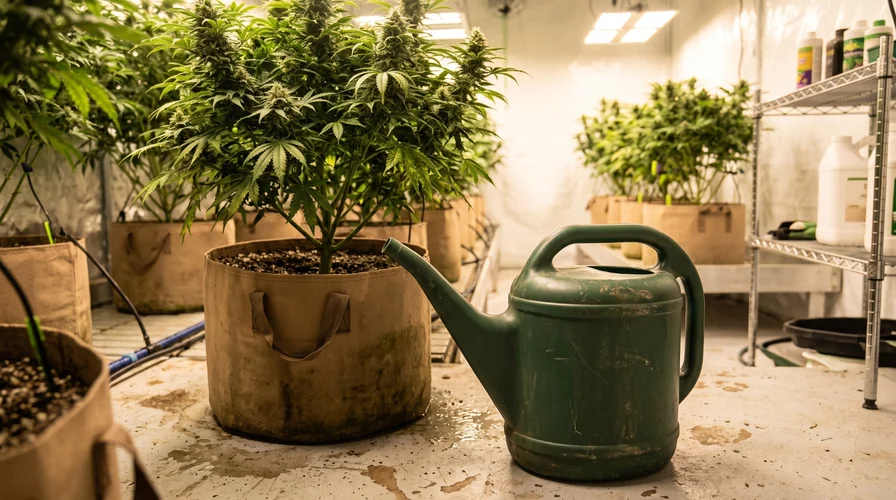
How Water Problems Show Up in the Plant
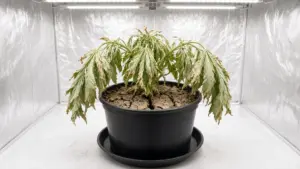
Water rarely produces a symptom that says “water.” It produces symptoms that look like feeding mistakes, which is why growers chase nutrients for months while the actual variable never changes.
The signature that gives it away is time. Water-driven problems are cumulative and progressive. Something mixed into every irrigation gets a little worse each week, so the pattern is a slow slide across a whole run rather than a sudden onset. Look for these:
- A runoff pH that climbs week after week even though your input pH is dialed in, which is alkalinity accumulating in the medium
- Interveinal yellowing on new growth that does not respond to more iron, because the pH has moved out of the range where iron is available
- Rising runoff EC that will not come down after a heavy flush, which points to a mineral going in that nothing is taking out, sodium being the usual suspect
- Calcium and magnesium deficiency in a grower running reverse osmosis or naturally soft water without supplementing
- A living soil that has quietly gone flat, with slow growth and none of the microbial activity it had earlier, in a house on chloraminated water
- Chalky white scale on pot rims, drippers, and tray edges, which is a visible confession of high mineral content
One more pattern worth naming: the grower whose plants do fine in soil and fall apart the moment they switch to coco, using the same water and the same nutrients. That is not a coco learning curve. That is a water source whose alkalinity was being absorbed by soil buffering and now has nothing standing in its way.
Choosing a Fix That Fits the Problem
Every option below solves something specific. Buying the most aggressive one by default is how growers end up creating new deficiencies while solving nothing they actually had.
Letting It Sit or Aerating
Free, and it addresses exactly one thing: free chlorine. An open container overnight, or 30 minutes to an hour with an air stone, handles most of it. Useless against chloramine, hardness, alkalinity, or sodium. Worth doing if chlorine is your only issue and you care about soil biology.
Carbon Filtration
A carbon block filter, whether inline on a hose or under the sink, removes chlorine and, given a filter rated for it with enough contact time, chloramine as well. It leaves your calcium and magnesium intact, which is usually what you want. This is the right buy for a living-soil grower on chloraminated municipal water, and it is inexpensive compared to the alternatives. It does not touch hardness, alkalinity, or sodium.
Reverse Osmosis
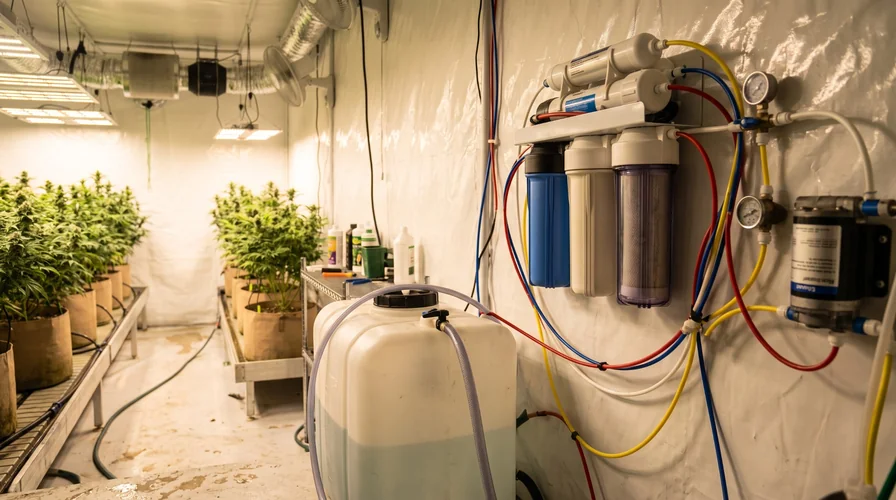
Reverse osmosis strips nearly everything, which makes it the correct answer for genuinely problematic water: high sodium, very high alkalinity, or a well with a chemistry you cannot otherwise control. It gives you a blank slate and total control over what your plants receive.
It also comes with real costs. You are now responsible for supplying all the calcium and magnesium yourself, so a Cal-Mag supplement moves from optional to mandatory. Zero-mineral water has essentially no buffering capacity, so its pH swings wildly on very small inputs and is genuinely annoying to adjust until you get used to it. Systems produce wastewater, run slowly, and need membrane replacement. Choose reverse osmosis because your water report told you to, not because a forum did.
Blending
The most underrated option. Cutting hard tap water with reverse-osmosis or distilled water at a ratio like 1 part to 1 part, or 1 part tap to 2 parts filtered, drops your starting mineral load and alkalinity to something workable while keeping some of the free calcium and magnesium and some buffering capacity. It also stretches a small reverse-osmosis system a long way. Mix a batch, check it with your meter, and adjust the ratio until your starting point sits where you want it.
Adjusting the Feed Instead of the Water
Sometimes the cheapest fix is on the nutrient side. Several manufacturers publish hard-water versions of their base feeds with the calcium and magnesium reduced accordingly, and using one prevents you from stacking their minerals on top of your water’s. If alkalinity is your problem specifically, a pH-down based on a stronger acid brings water into range with less product and holds it there better than a weak one. And when high alkalinity is driving media pH upward over time, an input pH at the lower end of your target range gives you a little room before it drifts out.
Whatever you do, keep your target ranges in mind: roughly 6.0 to 7.0 for soil and roughly 5.5 to 6.5 for coco and hydroponics. Those are the windows where the full set of nutrients stays available, and everything in this article is ultimately about keeping the root zone inside them.
Well Water Deserves Its Own Test
Well water has no report behind it, no treatment, and no obligation to be consistent. It can be excellent, and plenty of growers run it happily for years. It can also carry very high hardness, high iron, sulfur, nitrates from nearby agriculture, or seasonal bacterial contamination, and none of that is visible in a glass.
If you grow on a well, pay for a lab test rather than guessing. A basic panel covering hardness, alkalinity, pH, sodium, iron, sulfate, nitrate, and total dissolved solids is inexpensive and tells you in one shot which of the fixes above you actually need. Retesting every couple of years is reasonable, and testing after any major change in the well or a nearby land use is smart. Nitrate is worth particular attention because it is invisible fertilizer: water carrying meaningful nitrate is feeding your plants nitrogen you did not account for, which can leave a plant lush and leafy deep into flower when you wanted it winding down.
The One Source To Refuse Outright
Water from a conventional ion-exchange softener is the single clearest no in this whole subject. A softener does not remove hardness minerals in any useful sense. It swaps them out, releasing sodium into the water in exchange for the calcium and magnesium it captures. The result is water that has lost the two minerals your plants wanted and gained the one mineral they cannot use, at a concentration that scales with how hard the incoming water was.
Practically speaking, that means finding a tap upstream of the softener. Outdoor spigots are frequently plumbed before it, and so is the cold line to a kitchen sink in some houses. Check your plumbing before you assume, and if there is no bypass, use a different source. Potassium chloride softeners are less harmful than sodium chloride models, but they are still loading the water with something your feed program already supplies.
Frequently Asked Questions
Can I water cannabis with tap water straight from the faucet?
In much of the U.S., yes. Municipal water with moderate hardness, modest alkalinity, and low sodium works well in soil with no treatment beyond adjusting pH if needed. The cases that need intervention are high alkalinity in coco or hydro, elevated sodium, chloramine with a living-soil program, and untested well water. Read your report before you decide either way.
What TDS reading is too high for a source water?
Source water under roughly 200 ppm leaves plenty of room to build a full feed on top of it without overshooting your target EC. From roughly 200 to 300 ppm, you should account for what is already in the water when you mix. Above roughly 300 ppm, the composition matters more than the number, because water that high in usable calcium and magnesium is a very different situation from water that is high in sodium and bicarbonate. TDS tells you how much is dissolved, not what it is.
Does boiling tap water make it safe for plants?
Boiling drives off chlorine and kills pathogens, but it does nothing about hardness, alkalinity, or sodium, and it concentrates them slightly as water evaporates. It is impractical at grow volumes and solves less than a carbon filter costing a few dollars.
Why did my pH drift up after watering when I set it correctly?
High alkalinity is the most likely explanation. Bicarbonates in the water neutralize the acid you added and continue to raise pH in the medium after the water is in the pot. Test your alkalinity rather than just your pH, and treat the alkalinity itself through blending, a stronger acid, or reverse osmosis.
Do I still need Cal-Mag if I use tap water?
Often not, or not at full strength. Moderately hard tap water already supplies meaningful calcium and magnesium, and stacking a full supplement dose on top can push you into excess. Growers on reverse osmosis, distilled water, or naturally soft water do need to supplement, because their water supplies almost none. Let your hardness number make the call.
Is bottled or distilled water a good option?
Distilled water works chemically and behaves like reverse osmosis, meaning it needs full mineral supplementation and offers no buffering. The problem is cost and volume, since a mature plant can drink a gallon or more per day in peak flower. It is reasonable for seedlings, clones, or a single plant, and it stops making sense at any scale.
Can chlorinated tap water hurt beneficial microbes in living soil?
It can suppress them, which is why growers running compost teas, mycorrhizal inoculants, or a no-till bed should filter or off-gas their water. Free chlorine leaves on its own in 12 to 24 hours in an open container. Chloramine does not, and it needs carbon filtration. In a synthetic salt program, the concern is largely academic.
How can I tell whether my water or my nutrients are the problem?
Measure the water alone, before anything is added. Take a pH and EC reading on the raw source and check its alkalinity, then compare that against what you expect your mixed feed to be. If your raw water is already contributing a third of your target EC, or its alkalinity is fighting your pH adjustment, you have located the variable. Water problems also progress steadily across a run, while nutrient mistakes tend to appear right after a change you made.
Good Water Is the Cheapest Upgrade in the Room
Nobody posts about their water. It gets no attention next to lights and genetics, and yet it is the one input that touches the plant at every single irrigation from germination to the final week. Pull up your utility’s annual report, buy a meter and a hardness kit, and spend one afternoon learning your own numbers. You will either find out your tap water is a perfectly good foundation and save yourself the cost of a filtration system, or you will find the one line item that has been quietly undermining your last several runs. Either outcome is worth an afternoon.
Once your water is a known quantity, the next variable worth being deliberate about is what you put in the pot. Stable, well-documented genetics let you attribute what you see in the canopy to your inputs rather than to a coin flip, and that is what makes the rest of this troubleshooting possible. Shop breeder-direct at Seeds Here Now and start your next run on seeds that give you a reliable baseline to grow against.
Suggested Articles

 09 Nov 2026
 7 min read
;)
;)
;)
 October 16, 2026


RESPONSES (0)
No responses yet. Be the first to respond!