


CO2 for Cannabis: When It Actually Pays, and When It’s a Waste of Money
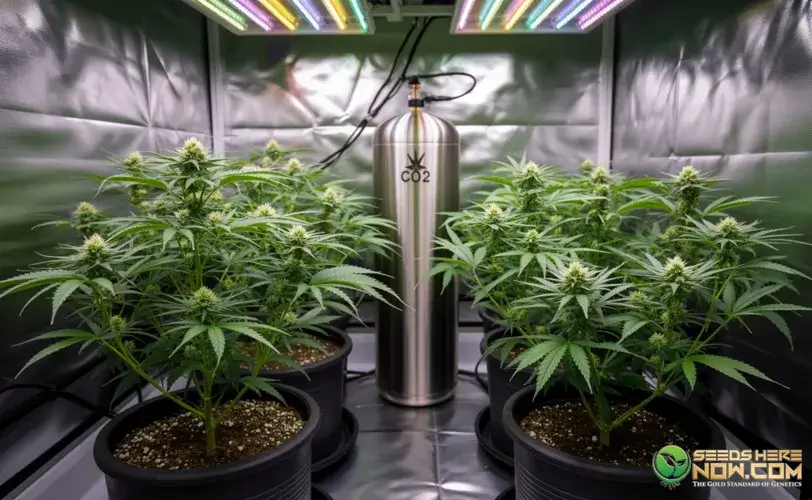
Let me save you some money right up front. CO2 is the most oversold upgrade in indoor growing. Every forum guy who bought a tank swears it doubled his yield. It didn’t. CO2 works — it genuinely does — but only when everything else in your room is already maxed out. Run it in a mediocre environment under weak lights and you’ve bought an expensive way to gas yourself while your plants shrug.
I’ve been growing and selling seeds for 16 years. Here’s the honest breakdown: what CO2 does, the numbers that matter, and the prerequisites that decide whether it’s worth a dime.
Why Cannabis Responds to CO2 at All
Cannabis is a C3 plant. Photosynthesis takes light, water, and carbon dioxide and turns them into sugar. CO2 is one of the raw ingredients. Outdoor air sits around 420 ppm these days, and at that level CO2 is usually the limiting factor once you crank the light up — the plant has more light energy than it has carbon to use.
Add more CO2 and the plant can photosynthesize faster, build sugar faster, and grow faster. Under the right conditions you’re looking at maybe a 20–30% bump in growth rate and yield. That’s real. But read the next section carefully, because “the right conditions” is the entire catch.
The Prerequisites (Read This Before You Buy Anything)
CO2 is not a base upgrade. It’s the last upgrade — the thing you add after everything else is dialed. Here’s why. Photosynthesis is limited by whatever input is in shortest supply. If your light is weak, light is the limit, and dumping in CO2 does nothing because the plant can’t use it. Same with temperature. CO2 only helps if it’s the bottleneck, and it’s only the bottleneck when these boxes are checked:
1. High light intensity — this is the big one. To use elevated CO2, your canopy needs serious PPFD, roughly 1,000–1,500 µmol/m²/s. That means strong, close LED or high-wattage HPS. At normal light levels (400–600 µmol) the plant tops out its CO2 use around ambient and extra gas is wasted. No strong light, no reason to run CO2. Full stop.
2. Higher temperature. Elevated CO2 lets the plant run hotter without stress. The optimal daytime temp shifts up to roughly 85–90°F (29–32°C) with CO2, versus ~75–82°F without it. If you’re holding 78°F, you’re leaving most of the CO2 benefit on the table. The gas and the heat work together — one without the other is half a system.
3. A sealed room. CO2 enrichment only makes sense in a sealed environment. If you’re actively exhausting air, you’re blowing your expensive CO2 straight out the duct. You can’t enrich and vent at the same time. That means a sealed room with AC and a dehumidifier to handle heat and moisture, because you’ve given up your exhaust for cooling.
4. Everything else already dialed. Feed, pH, VPD, airflow, root health. CO2 amplifies a good grow. It does nothing for a struggling one. If any of these are off, fix them first — they’re cheaper and they matter more.
Miss any of these four and CO2 is money lit on fire. That’s not me being cautious. That’s the plant physiology.
Target CO2 Levels by Stage
Assuming the prerequisites are met, here’s where to run it. Ambient is ~420 ppm; enrichment targets:
- Seedlings / clones: leave it at ambient (~400–420 ppm). No root system, low light, nothing to gain. Don’t bother.
- Vegetative: 800–1,000 ppm. Faster veg, quicker to flip. Nice but not essential.
- Flowering (weeks 1–5): 1,200–1,500 ppm. This is the payoff window. Peak light demand, peak growth, peak CO2 benefit. If you run CO2 anywhere, run it here.
- Late flower (last ~2 weeks): back down to ambient / off. The plant’s uptake drops as it finishes, and you save gas. No point enriching plants that are done stacking.
Do not chase numbers above 1,500 ppm. Past that you hit hard diminishing returns, and above roughly 2,000 ppm CO2 becomes toxic to the plant — it starts hurting instead of helping. More is not better. There’s a peak, and it’s around 1,200–1,500 ppm in flower.
CO2 only during lights-on. Photosynthesis needs light. The plant doesn’t use CO2 in the dark, so injecting it lights-off is pure waste. Tie your CO2 to your light cycle.
Methods of Supplementation
- Compressed CO2 tanks + regulator + controller. The clean, precise route. Consistent, controllable, no heat, no humidity added. My pick for anyone serious. Ongoing cost is refills.
- CO2 burners (propane/natural gas generators). Cheap gas per ppm and great for big rooms, but they throw off heat and water vapor — which, in a sealed room running warm, means more AC and dehumidification load. Fine at scale, overkill for a tent.
- Fermentation buckets / CO2 bags (mycelium). Hobby-tier. They produce a trickle of CO2 that gets nowhere near enrichment levels in a real room with any air exchange. Honestly, in a vented tent they’re mostly decoration. Save your money.
- Dry ice. Works in a pinch, impossible to control precisely, constant resupply. Not a real system.
Controllers, Monitors, and Safety
If you’re enriching, you need a CO2 controller with a real sensor (NDIR type) that injects to hold a setpoint and shuts off when it’s hit. “Set a timer and guess” wastes gas and swings your levels all over.
And take the safety seriously. CO2 is heavier than air, colorless, odorless, and at high concentrations it will make you dizzy, then unconscious, then worse. Enriching to 1,500 ppm for plants is fine for you; a leaking tank or a burner in a small sealed room is a genuine hazard. Put a CO2 alarm rated for human safety in the room. Non-negotiable when you’re running tanks or burners in an enclosed space.
The Cost-Benefit Reality
Here’s the part the upsell crowd skips.
Commercial / large sealed rooms: CO2 usually pencils out. When you’ve already got 1,000+ µmol lighting, AC, sealed walls, and a tuned feed program across a big canopy, a 20–30% yield bump on volume pays for tanks and controllers fast. Makes total sense.
Hobby grower in a tent: usually not worth it. To do CO2 right you’d have to seal the tent, add AC, add a dehumidifier, upgrade lights if they’re weak, and buy a controller and tank. By the time you’ve spent all that, you’d have gotten more yield-per-dollar by simply adding another light or a second small tent. For most home growers, CO2 is the thing you get to last, after the rest of the room is genuinely maxed — and a lot of tents never get there.
Run the math before you buy. Total up the tank or burner, the controller and sensor, the AC and dehumidifier you’ll need once the tent is sealed, and any lighting upgrade to hit that 1,000+ µmol threshold. Then compare it against the cost of one more quality LED bar over the same footprint. Nine times out of ten in a small space, the extra light wins on yield-per-dollar and comes with none of the safety headache. CO2 rewards scale and a fully built-out room. It punishes half-measures.
If you can’t check all four prerequisites, put the CO2 money into better light, better environment control, or better genetics. Every one of those returns more.
Common Mistakes I See Constantly
- Running CO2 under weak light. The number one waste. No high PPFD, no benefit. Period.
- Enriching a vented room. Blowing gas out the exhaust in real time.
- Running CO2 at night. Plants don’t photosynthesize in the dark.
- Chasing 2,000+ ppm thinking more is better. It’s toxic up there.
- Ignoring temperature. Not raising temps to match means you only get a fraction of the benefit.
- No safety alarm. Gambling with your own health to grow plants.
Frequently Asked Questions
Does CO2 really increase cannabis yields?
Yes — roughly 20–30% under the right conditions — but only when your light is already intense (around 1,000–1,500 µmol/m²/s), your room is sealed, and your temps are raised to match. Without those, CO2 does little or nothing, because it’s only useful when it’s the limiting factor in photosynthesis.
What CO2 ppm is best for flowering cannabis?
1,200–1,500 ppm during lights-on in early-to-mid flower, then back down to ambient in the last couple of weeks. Don’t exceed 1,500 by much; above ~2,000 ppm CO2 becomes toxic to the plant and yields drop.
Do I need CO2 for a small tent grow?
Almost never worth it. Doing CO2 right means sealing the tent, adding AC and a dehumidifier, and running strong lighting. For most home growers that money buys more yield if you spend it on an extra light or better genetics instead. CO2 is the last upgrade, not the first.
Should I run CO2 at night?
No. Photosynthesis needs light, so plants don’t use CO2 in the dark. Tie your CO2 injection to your lights-on period only — running it during lights-off is pure waste.
Dial the Room First, Then Feed It Great Genetics
CO2 is the finishing touch on a grow that’s already firing on every cylinder. Get your light, temps, and environment right — and start with seed stock that can actually cash in on all that effort. Browse the Seeds Here Now catalog for tested genetics from the top breeders in North America and build your next run on a foundation worth optimizing.
Suggested Articles

 09 Nov 2026
 7 min read
;)
;)
;)
 July 29, 2025


RESPONSES (0)
No responses yet. Be the first to respond!