


Selecting Cannabis Seeds for Your Grow: A Guide | SeedsHereNow.com

This guide covers selecting cannabis seeds for your grow step by step, with practical tips from James Bean and the Seeds Here Now team for adult growers 21+.
Here’s the short version, growmie: the name on the pack tells you almost nothing. The lineage tells you everything.
I’ve popped more seeds than I can count in the 16 years I’ve been running Seeds Here Now, and I’ve watched the same mistake sink grow after grow. It isn’t lights. It isn’t nutrients. It’s growers buying a name instead of a cross — and then wondering why their tent doesn’t look like the photo that sold them.
So let me walk you through how I actually pick cannabis seeds. Not the generic “consider your grow space” checklist you’ve read on nine other sites. The genetics side. The part that decides your harvest before you’ve even wet a paper towel.
Two packs of “Gelato” are not the same plant
This is the thing nobody explains to new growers, and plenty of experienced ones haven’t fully clocked it either.
“Gelato” is not one genetic. It’s a family. The original work traces back to Sherbinskis, crossing Sunset Sherbet with a Thin Mint Girl Scout Cookies cut. That’s a specific plant, from specific parents, made by a specific breeder.
But the name got popular. So now you can walk into ten seed banks and find ten “Gelato” packs. One is a feminized S1 taken off a clone-only cut. One is an F1 someone made by hitting a Gelato-leaning female with an unrelated male. One is three generations removed from anything Sherbinskis ever touched, riding the name because the name sells.
Same word on the jar. Completely different plants in your tent — different stretch, different flower time, different terpene expression, different yield, different everything.
When I’m evaluating a pack to carry at SHN, I don’t read the name first. I read what’s behind the name: who made it, what the parents were, and whether the cross is stable enough that your pack grows out the way the listing promises.

How to read a lineage
The cross — that “Parent A x Parent B” line on the listing — is the single most useful piece of information you will find on any seed page anywhere. Here’s how I read it.
The mother tends to drive structure and yield
Look at the female side of the cross. If there’s a big, dense, heavy-yielding plant in there, expect a plant that wants to pack weight. If the mother is a stretchy sativa-leaning line, expect to be tying branches down. This isn’t a law of physics — genetics don’t read rulebooks — but as a first read on what’s coming, the mother’s structure is where I start.
The father drives the surprises
This is where breeders earn their money, and it’s the part growers skip.
You can’t see a male in a photo. Nobody puts the pollen donor on the label art. But the male selection is why one breeder’s cross hits and a knockoff of the same cross flops. A breeder who ran 200 males, flowered them out, tested the offspring, and kept one — that guy is selling you something fundamentally different than a guy who used the first male that didn’t die.
Resin production, mold resistance, how the cross throws terps, whether the offspring are consistent or all over the map: a lot of that rides on the father. When I hear a breeder talk in detail about their male selection, I lean in. That’s the tell of someone doing real work.
Read the generation: F1, S1, BX
These aren’t jargon for jargon’s sake. They tell you exactly how much variation to expect, which is a buying decision, not a botany lecture.
- F1 — the first cross between two different parents. You get hybrid vigor, and you get variation. Different plants in the same pack. This is not a defect; it’s the point. F1s are where you hunt.
- S1 — a plant crossed with a feminized version of itself. The offspring lean hard toward that one parent. Less variation, closer to the known cut. This is how clone-only genetics get into seed form.
- BX — a backcross, bred back toward one parent over generations to lock in a trait. Most stable of the three. Closest to “what you see is what you get.”
So: want a keeper you hunt for and hold onto for years? Regular F1s are where the magic lives. Want a predictable result without popping thirty plants? Lean feminized S1 or BX.
That’s a genetics decision. It’s got nothing to do with whether you’re a beginner or a 20-year veteran — I know 20-year vets who run nothing but fems because they want their known result, and first-year growers who go straight to regs because they want to hunt.
F2s, F3s and IBLs — where it gets interesting
Once you’re comfortable reading F1, S1 and BX, the rest of the alphabet opens up. And there’s a common misread here I want to fix.
An F2 is what you get when you cross two F1 siblings. Here’s the counterintuitive part: F2s are more variable than F1s, not less. People assume each generation gets more stable. Not true. The F1 generation is actually fairly uniform, because both parents brought their own consistent genetics to the table. It’s in the F2 that everything the parents were hiding comes apart and reshuffles.
Breeders call this the F2 explosion, and it’s where the real gems hide. Every recessive trait that was masked in the F1 finally has a chance to show up. That freak plant nobody expected? Almost always an F2. This is why serious breeders make F2s and run big populations of them — not because F2s are “better,” but because that’s where the range is widest and the outliers live.
For you as a buyer, that means an F2 pack is a hunting pack. Don’t buy one expecting ten similar plants. Buy one expecting a spread, and plan to run enough of them to find what you’re looking for.
F3, F4, and onward means the breeder kept selecting — crossing siblings that share the target trait, generation after generation, narrowing the range each time. By IBL (inbred line), the population is stable enough that the seeds mostly breed true. Landrace populations are the original IBLs — centuries of a plant reproducing in one place with no outside input. That’s why work from an outfit like Indian Landrace Exchange matters: those are the raw ingredients everything modern was eventually built from.
It’s the same tradeoff in every species. Stability and vigor pull against each other, and where a breeder chooses to sit between them is one of the real judgment calls in this craft.
Why the same seed grows differently in your garden
Here’s where I have to be straight with you about something the marketing never says.
Genetics set the ceiling. Your environment decides how close you get to it.
Take one pack, split it between two growers. One’s running a sealed room with CO2 and a rock-solid VPD curve. One’s in a closet with a fan pointed at it. Same seeds. Wildly different plants. That’s not the breeder’s fault and it’s not a lineage problem — that’s environment expressing genetics differently.
But — and this is the part that matters — no environment on earth makes a plant express traits that aren’t in its genetics. You cannot feed your way to a terpene profile that isn’t coded in. You cannot light your way past a weak male selection. There is no nutrient line, no training technique, no $2,000 fixture that fixes bad breeding.
I’ve watched growers spend two seasons blaming their setup for disappointing runs when the actual problem was they bought mystery genetics from an anonymous reseller for $40. You can’t out-grow bad breeding. Buy the ceiling first.
What about seed appearance? Mostly a myth
Since we’re here, let me kill something.
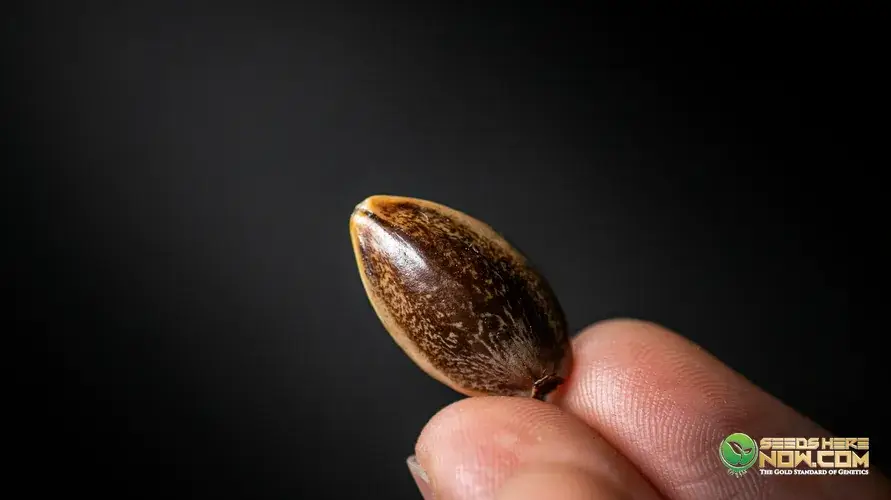
You’ll read that dark, tiger-striped, hard seeds are “mature and viable” and pale small seeds are “immature and won’t pop.” I’ve germinated thousands of seeds across 100+ breeders’ work, and I’ll tell you what I’ve actually seen: color and stripe pattern are largely genetic. Some lines just throw pale seeds. Some throw tiny seeds that grow into monsters.
Very green, very soft, and visibly crushed — sure, those are problems. But grading a pack by how pretty the seeds look is not a skill. It’s a superstition that got repeated until it sounded like knowledge. The lineage and the breeder tell you infinitely more than the shell does.
The three checks I run before I carry anything
This is my actual filter. Steal it.
1. Named breeder with a real track record
I only stock breeders with a longer track record than my own — and I’ve been at this since 2010. If nobody will attach their name to a pack, that is the answer. Anonymous genetics are anonymous for a reason.
Go look at who made it. Have they been working these lines for years? Do other growers post real grow logs of their gear? A breeder like Exotic Genetix has a decade-plus of public work you can go verify yourself. That’s what a track record looks like.
2. Full lineage listed
A breeder who’s proud of their cross tells you the parents. Full stop. When a listing says “premium indica hybrid” and nothing else, they’re either hiding something or they don’t know — and I’m not sure which is worse.
Every pack we carry lists the breeder and the cross, because after 16 years I know that’s the information that actually decides your harvest.
3. Chain of custody
Breeder-direct means the genetics in the pack are what the pack says. Every hand a pack passes through before it reaches you is another chance for the story to drift. Fake lineage doesn’t usually start as a lie — it starts as a game of telephone through resellers, and by the time it hits a shelf, “Gelato-ish” has become “Gelato.”
I’ve publicly refused to carry packs whose lineage claims I couldn’t stand behind. Cost me money. Would do it again.

Bottom line
Pick the cross, not the name. Match the generation to your goal — F1 regs to hunt, S1 or BX fems for a known result. Buy breeder-direct so the lineage is real.
Do that, and you’ve made the highest-leverage decision in your entire grow before you’ve germinated a single seed. Everything downstream — your lights, your medium, your feed — is you trying to reach a ceiling that was set the day you clicked “add to cart.”
Set it high.
Reviewed by James Bean, July 2026 — founder, Seeds Here Now. 16 years in cannabis genetics, direct relationships with 100+ breeders, 100,000+ growers served.
Ready to pick by lineage? Browse regular seeds for pheno hunting → | Shop feminized for a known result → | See all 100+ breeders we carry →
Selecting cannabis seeds for your grow: Further Reading
For more on selecting cannabis seeds for your grow, these related Seeds Here Now guides go deeper: grow lights for cannabis seeds, grow your own cannabis at home, how to grow feminized marijuana seeds indoors. For background reading, see Cannabis cultivation (Wikipedia).
To put this into practice, browse our feminized cannabis seeds, autoflower seeds, cannabis clones. Every listing names the breeder and lineage so you can match the genetics to your space and your goals.
Suggested Articles

 09 Nov 2026
 7 min read
;)
;)
;)
 October 04, 2024


RESPONSES (0)
No responses yet. Be the first to respond!