


Cannabis Nutrient Schedule: A Week-by-Week Feeding Framework That Actually Works

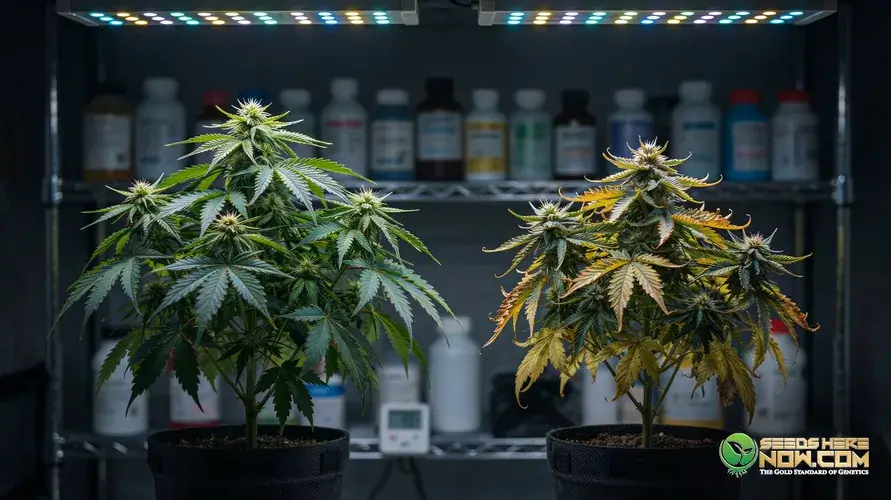
The feed chart on the side of the bottle was not written for your plant. It was written for an average plant that doesn’t exist.
That’s the whole article, but stick with me, because the useful part is what to do instead — and it starts with the lineage, not the label.
I’ve been sourcing genetics since 2010 and I’ve watched this scene burn a staggering amount of money on nutrients while feeding every plant in the tent identically. Two plants from different lines, fed the same schedule, will give you two completely different results. One will be lush and hungry for more. The other will have crispy brown tips by week four.
Neither of those is a nutrient problem. It’s a genetics problem being solved with a nutrient bottle.
Feed tolerance is inherited
Here’s the thing nobody puts on the chart: how much a plant wants to eat is a genetic trait, same as flower time or stretch.
It comes down the family tree from the parents, just like everything else. And once you know that, the whole “what’s the best nutrient schedule” question dissolves into a better one: what does this particular line want?
Broadly — and I mean broadly, because genetics don’t read rulebooks — here’s what 16 years of watching packs grow out has taught me.
Chem and Diesel lines: heavy eaters
Anything with real Chemdog or Sour Diesel in the lineage tends to be a pig. These lines will take a feed that would torch something else and ask for seconds. They’re vigorous, they’re hungry, and if you feed them timidly you’ll spend the whole run watching a pale plant underperform while you wonder what’s wrong.
What’s wrong is you’re feeding a linebacker a salad.
Haze and equatorial sativa lines: light eaters
Long-flowering Haze-leaning genetics are frequently the opposite. Feed them like a Chem and you’ll see tip burn, then clawing, then a plant that shuts down and sulks for two weeks.
These lines evolved in low-input environments. They’re efficient. They do not want your aggressive bloom booster, and telling them otherwise costs you the run.
Modern dessert hybrids: it depends, and that’s the point
Your Gelato-and-Cookies-descended lines are the interesting case, because “it depends on the pheno” is a real answer here. In an F1 pack you may genuinely have a heavy eater and a light eater in the same pack, from the same breeder, sown the same day.
Which is exactly why a single chart applied to a whole tent is a losing strategy.

Why the chart on the bottle exists
Let me be fair to the nutrient companies for a second, and then let me be honest about them.
Fair: a chart has to exist. They can’t print a schedule for every line in the world, so they print one for a hypothetical average plant, run at a strength that looks impressive in a marketing photo.
Honest: that chart is also a sales document. It sells bottles. Most published schedules run hot — well above what most plants actually want — and a large fraction of the “deficiencies” growers chase are actually the downstream wreckage of feeding at chart strength in the first place. Lockout from over-feeding looks a lot like a deficiency, so people respond by adding more. That’s a great business model. It’s a lousy grow.
I’m not telling you to throw the chart out. I’m telling you the chart is a starting point, and the plant is the actual instruction manual.
How to feed by lineage: my actual method
Here’s what I’d do if I handed you a pack tomorrow.
1. Read the cross before you mix anything
Go look at the parents. Chem, Diesel, OG, Sour in the family? Plan to feed on the heavier side. Haze, landrace sativa, anything equatorial and long-flowering? Plan to feed light. Dessert hybrid F1? Plan to watch, because you’ll have a range.
This takes 90 seconds and it’s the highest-value nutrient decision you’ll make all season. It’s also why I insist every pack we carry lists its full lineage — that information isn’t trivia, it’s an operating manual. If your seed bank won’t tell you the cross, they’ve taken your instruction manual away.
2. Start at half the chart
Every time. Regardless of line. You can always add. You cannot un-burn a plant, and the two weeks it takes to recover from lockout costs you more than the nutrients you “saved.”
3. Let the plant vote
The plant tells you what it wants, in order:
- Pale, slow, small — it’s hungry. Step up.
- Deep green with clawing tips, glossy “lacquered” leaves — too much nitrogen. Back off.
- Crispy brown tips creeping inward from the leaf edge — classic burn. Back off now, not next week.
- Lush, matte green, growing steadily — you found it. Don’t get clever.
That last one is where growers ruin runs. The plant is happy, so they add something. Don’t.
4. Feed the phenos separately
If you’re running an F1 pack and one plant is burning while another is pale, you have two different plants. Treat them like it. This is annoying, and it is also the entire reason experienced growers keep their hunts in individual pots rather than a shared res.
5. Write it down
When you find the keeper, write down what it ate. That’s part of the cut’s file. A keeper’s feed profile travels with the genetics — it’s as much a part of that plant as its flower time.

Let the plant tell you in numbers: runoff and EC
Everything above is reading leaves. Here’s how to stop guessing and get an actual number — and how that number ties straight back to the lineage.
EC (electrical conductivity) measures how much dissolved food is in your water. It’s the honest version of “how strong is this feed.” And the useful trick isn’t measuring what goes in — it’s measuring what comes out.
The runoff read
Water to about 15–20% runoff, catch it, and measure the EC. Compare it to what you fed:
- Runoff EC higher than input — the plant isn’t eating everything you’re giving it. Salts are stacking up in the medium. This is a hungry-looking plant that’s actually overfed and heading for lockout. Back off, and flush if it’s badly stacked.
- Runoff EC lower than input — the plant is eating more than you’re giving. It’s genuinely hungry. Step up.
- Runoff roughly matching input — you’re in the pocket. Leave it alone.
That’s it. That’s the whole technique, and it turns “I think it looks a little pale?” into a number you can act on.
Here’s where genetics shows up in the data
Run this on a full F1 pack and you’ll see the thesis of this article in hard numbers. Same tent, same feed, same day — and one pheno’s runoff comes back well over input while its sibling’s comes back under. Two plants from one pack, one stacking salt and one starving, on an identical schedule.
You didn’t do anything wrong. The chart was never going to work for both, because they aren’t the same plant. A Chem-leaning pheno and a Haze-leaning pheno out of the same cross are two different appetites wearing the same name.
Once you’ve seen that in your own runoff numbers, you stop believing in schedules and start believing in plants. It’s the fastest cure for chart worship I know of.
Two cautions
EC tells you how much food, not which food. You can be at a perfect EC and still be short on one element while long on another. It’s a strength gauge, not a full diagnostic.
And in living soil, throw most of this out. You’re feeding a biology that feeds the plant, not feeding the plant directly, and runoff EC doesn’t mean the same thing. That’s a whole different conversation — but the genetics principle underneath it doesn’t change one bit. A hungry line is a hungry line in any medium.
The stuff that actually matters more than your brand
Growers argue about nutrient lines like it’s football. Here’s my genuinely unpopular opinion after 16 years: the brand is close to the least important variable on the table.
What actually decides whether your feed works:
- pH. Wrong pH means the plant can’t take up what you gave it, no matter what you gave it. This is the single most common cause of “my expensive nutrients aren’t working.”
- Strength. Covered above. Most people run hot.
- Consistency. A mediocre schedule applied consistently beats a perfect schedule applied chaotically.
- Water. Your tap water already has a mineral profile. It’s part of your feed whether you account for it or not.
- Genetics. Which is where we came in.
Notice “which brand” isn’t on that list. Any competent line, run at the right strength and the right pH, for genetics that match, will get you where you’re going.
The additive question
Straight answer, since you’d get one from me at the booth: most additives are a waste of your money.
The bloom boosters, the terp enhancers, the “unlock your plant’s potential” bottles — they’re selling you the idea that you can buy your way past your genetics. You can’t. That’s the whole thesis of this article.
If a line doesn’t make gas, no bottle makes it gas. If it doesn’t stack, no bottle stacks it. The money you’d spend on a shelf of additives buys you one pack from a breeder who spent a decade actually selecting for the trait you’re trying to purchase in liquid form.
That’s not me being cute. That’s the actual trade, and it’s not close.
Bottom line
Stop asking “what’s the best cannabis nutrient schedule.” There isn’t one, because there’s no such thing as an average plant.
Read the cross. Chem eats, Haze doesn’t, hybrids vary. Start at half strength. Let the plant vote. Feed your phenos individually. Get your pH right and stop buying bottles that promise to fix genetics.
Feed the plant in front of you — the one whose parents you took 90 seconds to read about before you mixed anything.
Reviewed by James Bean, July 2026 — founder, Seeds Here Now. 16 years in cannabis genetics, direct relationships with 100+ breeders, 100,000+ growers served.
Feed starts with knowing the cross. Every pack we carry lists its full lineage. Shop regular seeds → | Shop feminized → | Browse breeders →
🌱 New to this? Start with our complete guide: Best Nutrients for Cannabis.
Suggested Articles

 09 Nov 2026
 7 min read


;)
;)
;)
 October 22, 2024


RESPONSES (0)
No responses yet. Be the first to respond!