


Cannabis pH Issues and How To Correct Them
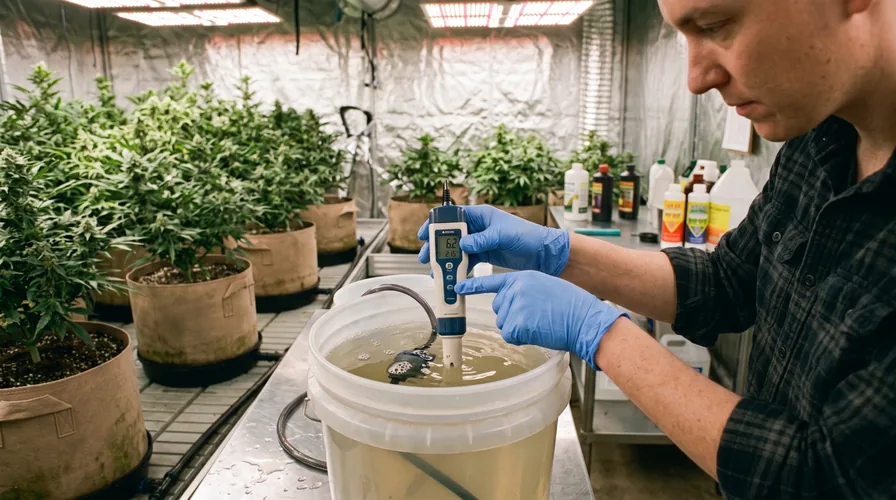
Most of what gets reported to me as a pH crisis turns out to be an instrument problem wearing a plant costume. A grower sends photos of yellowing new growth, tells me the reservoir reads 5.8 every single time, and asks what nutrient to add. My first question is never about the nutrient. It is how old the calibration solution is, and whether the probe has been sitting in a dry cap or a jar of distilled water since last season. Roughly half the time, that is the whole conversation. The pen was lying, the grower trusted it, and the root zone spent 6 weeks somewhere the grower never intended.
That is the awkward truth underneath most cannabis water pH issues. pH is the one variable in the room you cannot see, smell, or feel. You know it only through a device, and that device drifts, ages, and fails quietly. Everything downstream of a bad reading looks like a feeding mistake. So this article works outward from the pen to the plant: what pH is actually controlling, why your measurement is the first suspect, how the number changes between the mixing bucket and the roots, and what to do when the medium has already drifted out of range.
pH Is a Gatekeeper, Not a Nutrient
Nothing about pH feeds a plant. Rather, it decides what the plant is allowed to reach. Every mineral in your feed exists in a chemical form that shifts with the acidity of the solution around the roots, and some of those forms cross into root tissue easily while others may as well be gravel. Change the pH, and you change nothing about how much iron is in the pot. You change whether that iron is available.
This is why nutrient lockout is such a persistent trap. A locked-out plant shows textbook deficiency symptoms while sitting in a medium loaded with the exact element it appears to be missing. The grower reads the leaves, adds more of that element, and makes the salt load worse without moving the symptom at all. Meanwhile, the actual lever was never touched.
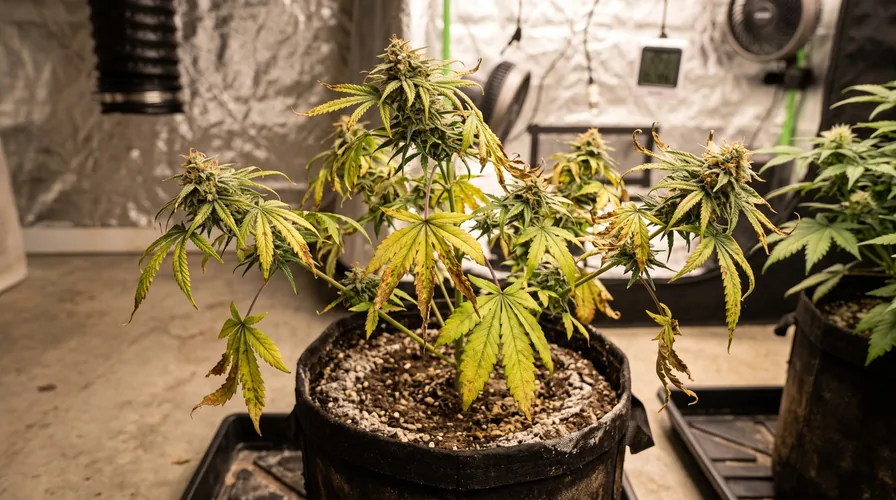
The direction of the drift tells you which elements go first. When root-zone pH climbs above the target window, the micronutrients are the first casualties: iron, manganese, and zinc all become progressively less available, and that shows up as interveinal yellowing on the newest growth while the veins themselves stay green. When pH falls too low, calcium and magnesium uptake suffers, and phosphorus availability narrows as well. Both directions can also stress the microbial life in an organic medium, which does its own share of nutrient cycling.
None of that is exotic chemistry you need to memorize. The practical takeaway is simpler: there is a fairly narrow window where the whole menu stays on the table, and your entire job is keeping the root zone inside it.
Suspect the Pen Before the Plant
A pH meter is a consumable, not a tool. The glass bulb at the tip is an active sensing surface, and it degrades with use, exposure, and neglect. A pen that was accurate a year ago is not automatically accurate today, and it will not warn you.
Calibration is the non-negotiable habit. Two-point calibration against fresh 4.0 and 7.0 reference solutions takes a couple of minutes, and doing it every 2 to 4 weeks in regular use is reasonable for most home growers. Reference solution has a shelf life, and it contaminates the moment you dip a dirty probe into the bottle, so pour a small amount into a separate cup for each calibration rather than dunking into the stock bottle. If your pen holds calibration for weeks and then suddenly cannot be calibrated at all, the bulb is finished, and it is time for a new probe or a new meter.
Storage kills more pens than use does. The bulb needs to stay hydrated in a proper storage solution. Distilled or reverse-osmosis water is actively harmful for storage because it pulls ions out of the sensing glass, and a dry cap lets the bulb dehydrate. Both shorten the life of a meter dramatically, and both are extremely common.
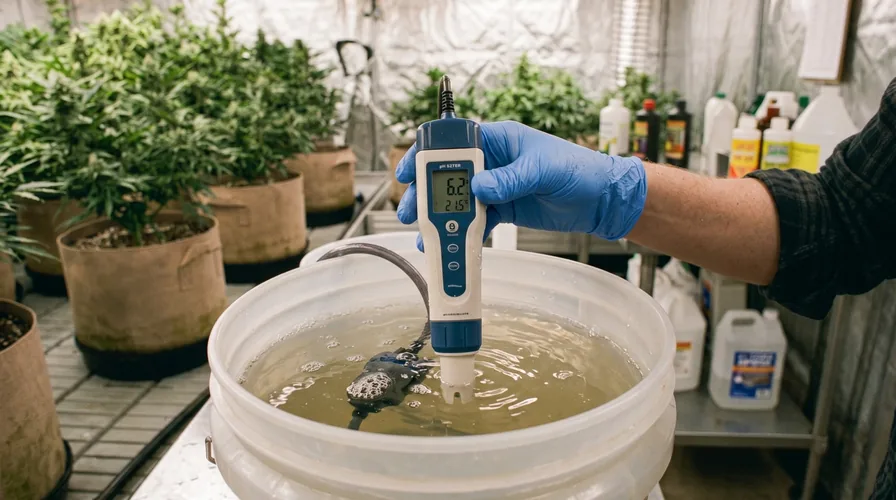
Two more measurement details matter more than people expect. Temperature affects both the reading and the true pH of the solution, so calibrate and measure at similar temperatures, and take advantage of automatic temperature compensation if your meter has it. And give the reading time to settle. A number that is still crawling when you write it down is not a measurement. Wait until it stops moving, which can take 30 to 60 seconds in low-mineral water.
Litmus paper and drop kits are a fair backup and a good sanity check on a suspect pen. They are not precise enough to manage a hydro reservoir, but they will tell you whether your meter is off by a full point, and that is often the only question that matters.
The Number Changes Between the Bucket and the Root
Here is where a lot of careful growers still get burned. You can measure a perfect 5.8 in the mixing bucket and still deliver something else entirely to the roots, because pH is not a fixed property of the liquid. It is the current balance of a chemical argument, and the argument continues after you stop watching.
Order of operations is the first place this shows up. Nutrients change the pH of the water, sometimes substantially, so pH has to be the last step in a mix. Fill the container, add your supplements and base nutrients in the order the manufacturer specifies, stir thoroughly, and only then adjust. Adjusting first and feeding second means the number you set no longer exists.
Even after a complete mix, solutions keep moving. Let a freshly mixed batch sit for 15 to 30 minutes, then read it again. Chelates, carbonates, and the acid or base you just added are still reacting, and it is normal for the reading to shift during that window. Setting it once and walking away is how a 5.8 becomes a 6.4 by the time it hits the pot.
Then the medium gets a vote, and it is a loud one. Soil with a healthy organic fraction and a real cation exchange capacity buffers incoming water toward its own equilibrium, which is why soil growers can be sloppy about input pH and still succeed. Coco and inert hydro media have almost no buffering capacity of their own, so what you deliver is very close to what the roots experience, and small mistakes are not absorbed by anything. That single difference explains most of the “it worked in soil and fell apart in coco” stories.
Recirculating reservoirs drift on their own schedule too. As plants take up nitrate, the solution tends to climb; as they take up ammonium forms, it tends to fall. Add evaporation concentrating the salts, and a reservoir you set on Monday can be somewhere else by Wednesday. Check it daily rather than assuming it stayed.
Targets Worth Aiming At
The windows most growers work inside are roughly 6.0 to 7.0 for soil, with many people preferring the middle of that band, and roughly 5.5 to 6.5 for coco and hydroponics, with 5.8 being the most commonly cited single number. Those are ranges rather than setpoints on purpose.
Deliberately varying your input within the range across feedings has a logic to it, since different elements peak in availability at slightly different points, and rotating across the window rather than pinning one number keeps everything reasonably accessible. It is not mandatory, and a stable single value inside the range will grow excellent plants. But it does mean a reading of 5.9 when you were aiming for 5.8 is not worth a second thought.
What matters far more than hitting a decimal is not living outside the window. A grower steady at 6.2 in coco every single feeding will do better than one who oscillates between 5.2 and 6.9 chasing perfection. Stability beats precision here, and by a wide margin.
Reading a Root Zone That Has Already Drifted
Input pH tells you what you delivered. It does not tell you where the root zone actually sits, and those two numbers separate over time. Runoff and slurry testing are how you close that gap, and both come with caveats worth knowing before you act on them.
Runoff pH is a rough signal, not a precise one. Water passing through a pot picks up whatever has accumulated in the medium, and the reading depends on how much you poured, how fast it moved, and how long it has been since the last feeding. The useful information is not any single runoff number. It is the trend across weeks. Runoff climbing steadily while your input stays fixed means something in the medium is pushing upward, and high-alkalinity source water is the usual driver. Runoff falling steadily while input holds means the medium is acidifying, which happens with heavy synthetic feeding in an inert medium.
For soil, a slurry test gives a more honest answer. Take a sample of root-zone medium, mix it with an equal volume of distilled or reverse-osmosis water, let it stand for roughly 30 minutes, stir, and read the liquid. That tells you where the medium itself sits rather than where a stream of water passing through it ended up.
The symptom pattern that points to pH rather than feeding is progression. A pH problem builds. Each irrigation nudges the medium a little further out of range, so you see a slow slide across a run rather than a sudden change after something you did. Watch for interveinal yellowing on new growth that does not respond to more of the element it looks like it is missing, a whole plant that fades and slows despite a full feed schedule, deficiency symptoms appearing in several elements at once, and new growth that comes in small, twisted, or oddly pale. Any of those alongside a runoff trend moving in one direction is a pH story, not a nutrient story.
Bringing a Drifted Medium Back
Correcting the medium is a different job from correcting the water, and doing it gently matters. Roots do not enjoy sudden chemical swings, and a panic response causes its own damage.
If the medium has climbed high, flush with a generous volume of pH-corrected water at the low end of your target range, roughly 2 to 3 times the container volume for coco or inert media, and check the runoff as you go. In coco, a flush with a mild calcium and magnesium solution helps recondition the medium as well as rinse it. Then resume normal feeding at a slightly lower input pH than usual and let the trend tell you whether it worked.
If the medium has gone too acidic, the same flush approach applies at the upper end of your range. In soil specifically, a small amount of dolomite lime worked into the top layer raises pH slowly and buffers against future slides, which is a better long-term answer than repeated flushing.
A few things to avoid while you are correcting. Do not chase runoff readings feeding by feeding, adjusting input pH up and down in response to every measurement, because the medium lags behind your changes and you will end up oscillating. Do not add nutrients during a corrective flush; you are trying to remove accumulation, not add to it. And do not expect the damaged leaves to recover, because tissue that lost its chlorophyll to a lockout stays that way. Your evidence that the fix worked is healthy new growth, which typically shows up within roughly 7 to 14 days once availability is restored.
Habits That Keep the Problem From Returning
Once your pH is under control, keeping it there is mostly procedural. Calibrate on a schedule rather than when something looks wrong. Store the probe in a proper storage solution and rinse it after every use. Adjust pH last in the mix, then wait and re-check before feeding. Log your input reading, your runoff reading, and the date, because the trend is the diagnostic, and you cannot see a trend you did not write down.
Treat pH-down as a precision instrument, not a splash. Concentrated acid moves the number fast, and overshooting means adding base to climb back, which builds up salts you did not need. Dilute it, add it in small increments, stir between additions, and creep up on the target.
Finally, know your source water, because chronic drift almost always starts there. If you have never checked your water’s alkalinity, that is the single most useful measurement left on the table, since high-alkalinity water will fight every adjustment you make and keep pushing the medium upward no matter how carefully you set the bucket.
Frequently Asked Questions
How Often Should a pH Pen Be Calibrated?
Every 2 to 4 weeks for typical home use, and more often if you measure daily or the pen has been stored badly. Always recalibrate after a new probe, a long idle period, or any reading that surprises you. Use fresh reference solution poured into a separate cup so you never contaminate the stock bottle.
Do I Need To Adjust Plain Water Between Feedings?
In coco and hydroponics, yes, because those media do not buffer and every irrigation delivers whatever you pour. In well-buffered organic soil, it matters much less, and many soil growers water with untreated tap water successfully. If your source water is high in alkalinity, adjusting even plain water is worth the trouble regardless of medium.
Is Runoff Testing Actually Worth Doing?
Yes, as a trend tool. A single runoff number is noisy and depends on volume and timing, so do not make decisions on one reading. Recorded weekly alongside your input, it is the earliest warning you will get that the medium is moving, often weeks before leaves show anything.
Can I Use Vinegar or Lemon Juice Instead of pH Down?
They will lower a reading, but they are weak organic acids that the microbial life in the medium consumes, so pH rebounds within days. That makes them unreliable for a reservoir and inconsistent in soil. Purpose-made pH adjusters use stronger mineral acids that hold, and they are inexpensive enough that improvising is a poor trade.
Why Does My Reservoir Climb Overnight?
Nitrate uptake by the plants and the buffering behavior of your water are the usual causes, with evaporation concentrating everything as a secondary factor. This is normal in recirculating systems. Check and adjust daily, keep the reservoir topped off, and change it out on a regular schedule rather than trying to hold one number forever.
What Range Should I Target in Coco Compared With Soil?
Roughly 5.5 to 6.5 in coco and hydroponics, with 5.8 the most common single target, and roughly 6.0 to 7.0 in soil. Coco is far less forgiving because it does not buffer, so accuracy and consistency matter more there than in a living soil bed.
How Long Does a Plant Take To Recover From Lockout?
New growth generally comes in healthy within 7 to 14 days once the root zone is back in range. Existing damaged leaves will not regreen, and a plant locked out during heavy flower may not fully make up the lost bud development before harvest.
Does pH Matter Less for Autoflowers?
No, and arguably it matters more. Autoflowers run on a fixed timeline and cannot extend their vegetative stage to recover from a lost 2 weeks. The targets are the same as for photoperiod plants; the margin for error is smaller.
Manage the Instrument, Then Manage the Plant
pH rewards boring discipline more than it rewards insight. A calibrated pen, a properly stored probe, adjustment as the last step of the mix, a target range instead of a magic decimal, and a written log of input and runoff will keep the root zone in range through an entire run without drama. The growers who struggle with it are almost never the ones who picked the wrong number. They are the ones who trusted a reading they had no reason to, or reacted to a single measurement rather than a trend.
Get the measurement honest, and the rest of your troubleshooting gets easier, because you can finally attribute what you see in the canopy to something real. Genetics with documented behavior make that even clearer, since you know roughly what the plant should be doing before you start diagnosing what it is not. Browse the breeder-direct catalog at Seeds Here Now and give your next run a baseline worth measuring against.
Suggested Articles
 10 Nov 2026
 12 min read

;)
;)
;)
 October 19, 2026


RESPONSES (0)
No responses yet. Be the first to respond!